
The best turbulence apps in 2026
Six turbulence apps compared from their App Store and Google Play listings in October 2026: what each forecast shows, who it suits, platforms and price models, plus how to choose.

If turbulence is the part of flying you dread, a forecast for your own route can take some of the surprise away. Several apps now do this, and they differ a lot: some only show a map, some send a hand-written forecast, some add breathing and pilot explanations for the moment the bumps arrive.
We make FlyNest. Other entries are tested against the same criteria from their public store listings, as listed on the US App Store and Google Play in October 2026. Prices and features change often, so check the store before you pay.
Practical answer
- Best for detailed forecasts: Turbulence Forecast, a world turbulence map, automated forecasts for your flight and optional forecasts written by turbulence forecasters. iPhone and Android.
- Simplest to use: Flying Calmly, type your flight number and date, get a turbulence report. The most-rated forecast app in this list, with a 4.8 average.
- Best when anxiety is the real problem: SkyGuru, turbulence zones on your route plus pilot explanations and exercises for panic, during the flight.
- Free, no app, no sign-up: FlyNest's web turbulence forecast, with the FlyNest app (our app) for calm during the flight.
Whichever you pick, remember what the forecast is for: knowing when it may get bumpy. Whether it is safe is a different question, and the answer is reassuring. The FAA explains that turbulence can throw passengers who are not wearing a seat belt from their seats, and that keeping the belt buckled is how passengers prevent injuries. Belted in your seat, turbulence is uncomfortable, not dangerous. More on that in is turbulence dangerous?.
How we picked
We searched the App Store for "turbulence" and "turbulence forecast" and kept apps that:
- Forecast turbulence for a passenger's own flight or route, not just a general weather map for pilots.
- Are maintained: updated in 2025 or 2026 according to the store.
- Are written for passengers, in plain words, rather than for pilots and dispatchers.
For each one we read the full store listing and noted platforms, price model and rating count as shown. We did not run accuracy tests, and we do not score or rank forecasts on accuracy: no public, independent comparison of passenger turbulence apps exists that we could check. Flight trackers without turbulence forecasts (such as general flight-tracking apps) are left out.
Comparison table
| App | What it forecasts | Calm tools | Platforms | Price model (store listing, Oct 2026) | US App Store ratings |
|---|---|---|---|---|---|
| Turbulence Forecast | World turbulence map, automated forecast for your flight, handcrafted forecasts by email | No | iPhone, iPad, Android | Free download, in-app purchases (forecast packs, ad removal) | 4.6 from 207 ratings |
| Flying Calmly | Turbulence report from your flight number and date; PLUS follows delays and the actual route flown | No | iPhone, iPad | Free, optional PLUS subscription ($6.99) | 4.8 from 821 ratings |
| Turbli+ | Turbli's turbulence forecasts and maps, saved flights offline, custom flights | Educational articles | iPhone, iPad (forecasts also on turbli.com) | Subscription ($4.99 a month or $19.99 a year) | 2 ratings |
| SkyGuru | Turbulence zones on your route, real-time explanations of what the plane is doing | Panic exercises, therapist-style support | iPhone, iPad, Android | Free download, per-flight or subscription purchases | 10 ratings |
| Turby | 1-10 severity score, timeline from takeoff to landing, seat suggestion, departure time comparison | Calm Mode with breathing and reassurance cards | iPhone, iPad | Free download, subscription (weekly, monthly or yearly) | 9 ratings |
| FlyNest (our app) | Free web forecast for any route and date, minute by minute | Nesty pocket captain, breathing, 12 meditations by flight phase | Web forecast in any browser; app on Android, iPhone coming | Web forecast free; app by subscription | Not yet on the App Store |
Ratings are the count shown on the US App Store listing on 21 October 2026. A low count usually means a newer app, not a worse one.
Turbulence Forecast
The longest-running app in this list. Its listing describes a world turbulence map, automated forecasts tailored to your flight, and "handcrafted" forecasts sent by email and written by forecasters with more than 20 years of experience.
- Who it suits: people who want to look at the map themselves, or who like the idea of a person reviewing their flight.
- Limits: the most detailed forecasts are bought in credits or packs, which can add up if you fly often. No in-flight calming tools.
- Price model: free download; in-app purchases listed between $0.99 and $34.99 (forecast packs, tiers, ad removal).
- Platforms: iPhone, iPad and Android.
Flying Calmly
Flying Calmly does one thing and does it simply: enter your flight number and date and get a report on how strong any turbulence may be and how likely it is. If your flight is a while away, it can send the report just before you fly. Its listing is clear that the reports come from publicly available weather data and that forecasts are not always right.
- Who it suits: anyone who wants an answer in ten seconds without reading a map.
- Limits: forecast only, nothing for the moment the bumps arrive. We found no Android version.
- Price model: free; the PLUS subscription ($6.99 on the US store) keeps the forecast current when your flight is delayed or rerouted.
- Platforms: iPhone and iPad.
We compared it with FlyNest in more depth in FlyNest vs Flying Calmly.
Turbli+
Turbli is a well-known turbulence forecast website; Turbli+ is its paid iPhone app. The listing adds saved flights that stay available offline during the journey, statistics across your saved flights, custom flights you enter by hand, and no ads. It also includes articles for anxious flyers based on a book by Turbli's founder written with a medical professional.
- Who it suits: people who already use the Turbli website and want it offline on the plane.
- Limits: requires an account and a subscription for the app features. Few ratings on the US store so far.
- Price model: $4.99 a month or $19.99 a year.
- Platforms: iPhone and iPad.
SkyGuru
SkyGuru is a fear of flying app first and a turbulence app second. Its listing says it predicts most turbulence zones on your route, so you know when it may get bumpy and for how long, and explains in real time what the aircraft is doing: turns, noises, holding, go-arounds, landing. It pairs this with exercises to stop a panic attack in your seat.
- Who it suits: people whose fear goes beyond turbulence, to noises, feeling trapped or fear of panic itself.
- Limits: a large toolkit (the listing mentions 50+ tools) can feel like a lot when you are already anxious. Pricing is per flight or per period, so compare before buying.
- Price model: free download; purchases listed from $4.99 to $69.99 (single flights, packs, monthly, yearly with a video course).
- Platforms: iPhone, iPad and Android.
See FlyNest vs SkyGuru for a side-by-side.
Turby
A newer app that turns the forecast into a 1-10 severity score and a timeline from takeoff to landing. Its listing also mentions a seat suggestion based on your flight's forecast, comparison of alternative departure times, and a Calm Mode with guided breathing (with haptic feedback) and reassurance cards.
- Who it suits: people who want one number and a timeline, plus some calm tools in the same app.
- Limits: young app with few ratings; requires a recent iPhone system (iOS 18 or later).
- Price model: free download; subscription listed at $4.99 a week, $12.99 a month or $49.99 a year.
- Platforms: iPhone and iPad.
FlyNest (our app)
FlyNest's turbulence forecast runs in your browser, free and without sign-up. Type your departure and arrival airports and your date: it reads the global GFS weather model along your route at cruising levels and shows, minute by minute, where bumps are likely, plus the winds at takeoff and landing. How to read a turbulence forecast explains each level.
The FlyNest app is built for what comes next: the flight itself. You can ask Nesty, the pocket captain, "is this turbulence normal?", follow your flight on a map that works offline, and play a guided meditation made for turbulence.
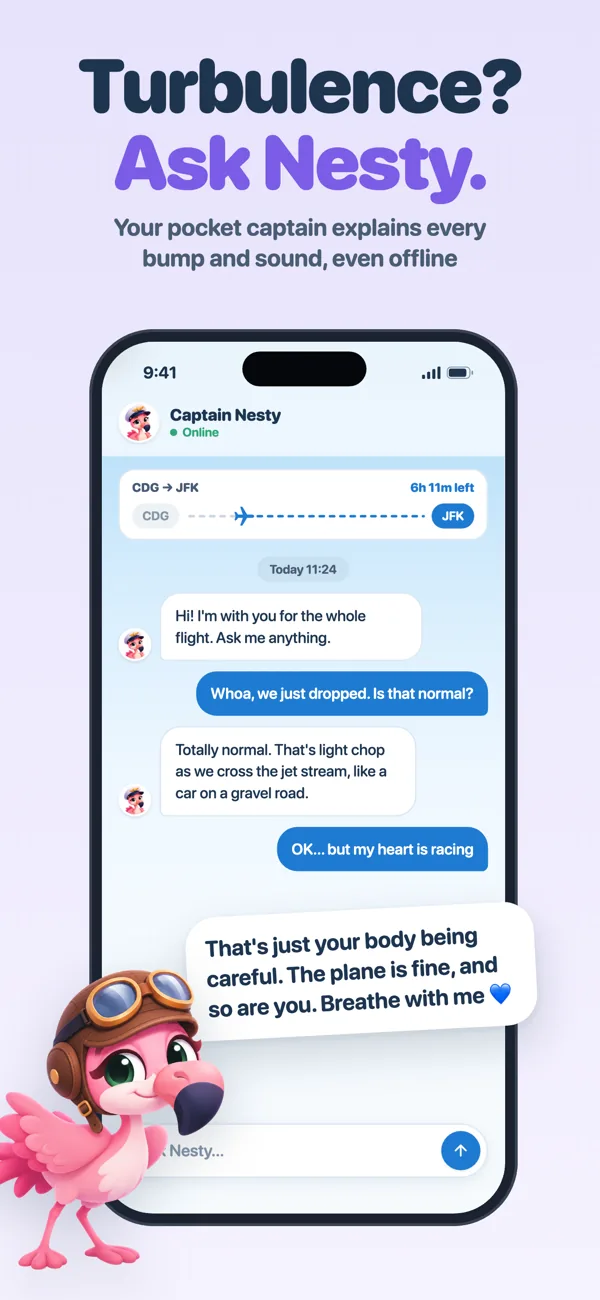
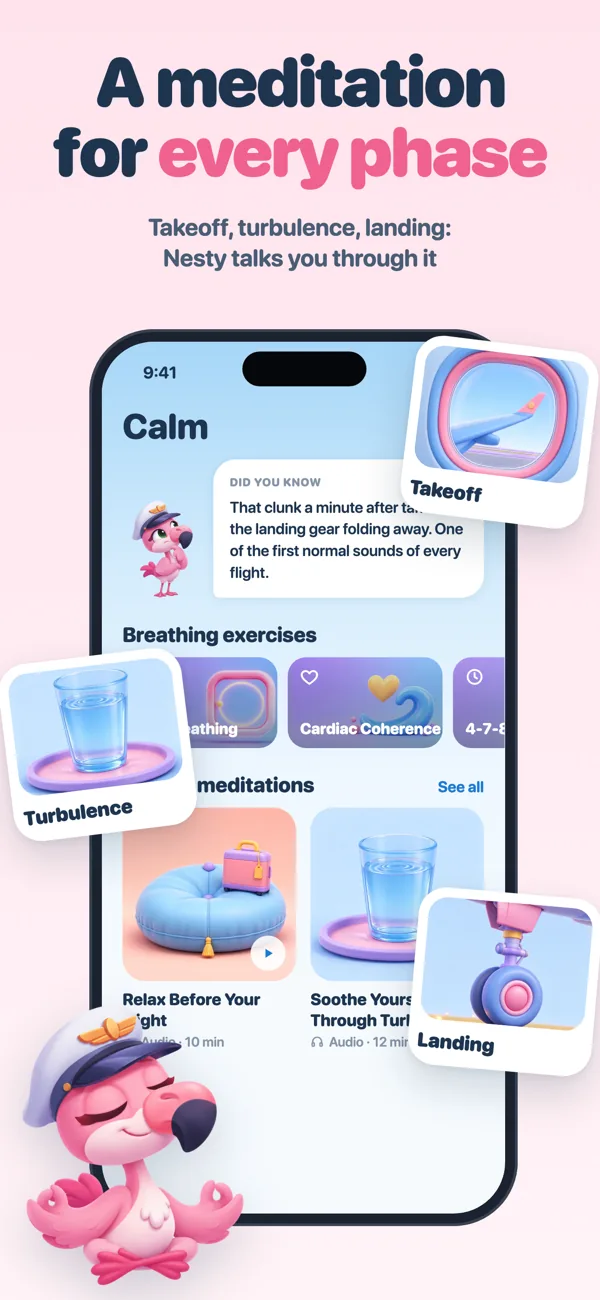
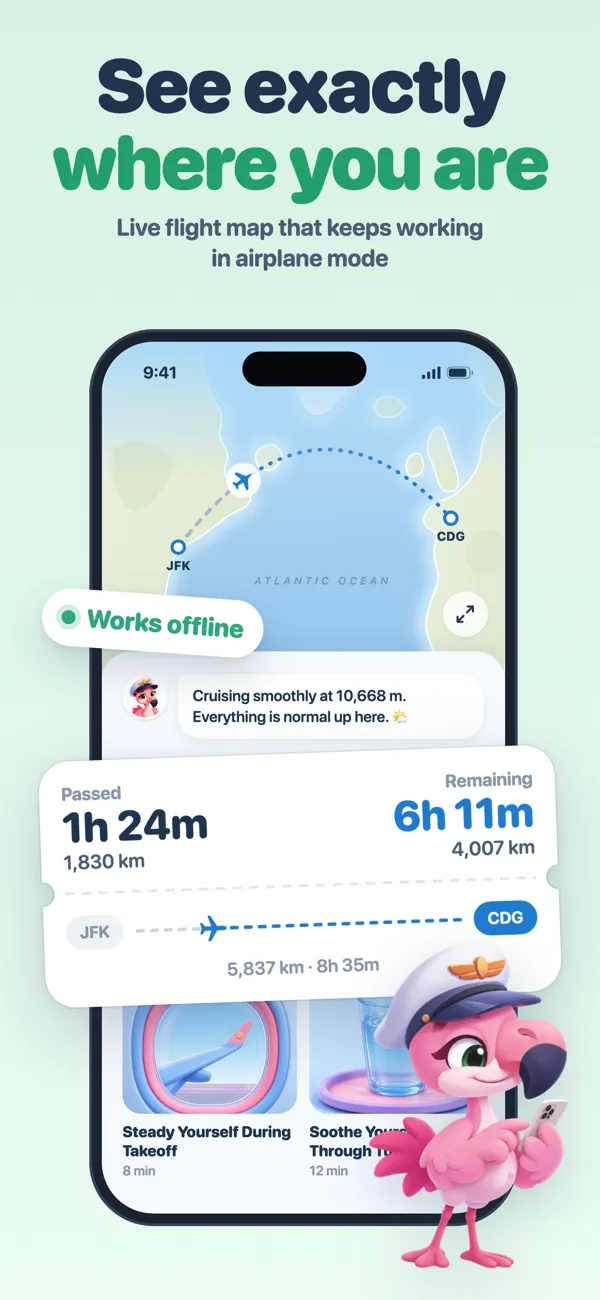
- Who it suits: people who want a free forecast first, and a calm companion for the moment the seatbelt sign comes on.
- Limits: the forecast is computed from a public weather model, not written by a forecaster, and it lives on the web rather than inside the app. The app is on Android now; the iPhone version is coming to the App Store.
- Price model: web forecast free; the app requires a subscription.
How to choose
- You only want to know what to expect: Flying Calmly for speed, Turbulence Forecast for detail, or FlyNest's free web forecast if you'd rather not install anything.
- You fly often and want forecasts offline: Turbli+ or Turbulence Forecast.
- Turbulence is one fear among several: SkyGuru or FlyNest, which add help for the flight itself.
- You are on Android: Turbulence Forecast, SkyGuru or FlyNest.
One honest warning: checking forecasts again and again can feed anxiety instead of calming it. Look once the day before and once on the morning of your flight, then put it away. If fear of flying is stopping you from travelling at all, a therapist trained in anxiety can help a lot; our guide on how to get over a fear of flying explains the approaches that work.
Frequently asked questions
Are turbulence apps accurate?
They are as good as the weather data behind them, and turbulence is hard to forecast precisely. Most use global weather models to estimate where wind shear and storms are likely along your route. They are good at showing likely bumpy stretches, not exact minutes. Pilots have better tools: detailed forecasts, live pilot turbulence reports from other aircraft, and they change altitude to find smoother air.
Is there a free turbulence app?
Flying Calmly's basic forecast is free, and Turbulence Forecast is a free download with paid extras. FlyNest's turbulence forecast is free on the web for any route, with no app or account needed.
Can a turbulence forecast tell me if my flight is safe?
No, and it doesn't need to. Forecasts describe comfort, not safety. Airliners are built to handle far more than passengers ever feel. The NTSB's 2021 study found that most turbulence accidents on US airlines from 2009 to 2018 caused injuries but no damage to the aircraft, and many of the people hurt were flight attendants working on their feet. Keep your belt fastened whenever you are seated.
Which turbulence app works offline on the plane?
Turbli+ lists saved flights that stay available offline. FlyNest's live map, breathing exercises and meditations work offline once downloaded. For other apps, check the listing, and open your forecast before take-off in any case.
What is the best seat if the forecast shows bumps?
Seats over the wings, near the plane's centre, usually feel the least movement. Our guide to the best seat for turbulence explains why.
Sources
- Turbulence Forecast on the App Store
- Turbulence Forecast on Google Play
- Flying Calmly on the App Store
- Turbli+ on the App Store
- SkyGuru on the App Store
- SkyGuru on Google Play
- Turby on the App Store
- FlyNest on Google Play
- FAA, Turbulence: staying safe
- NTSB, Preventing turbulence-related injuries in air carrier operations (2021)