The best books for fear of flying in 2026
Five fear of flying books compared in November 2026, from SOAR and Cockpit Confidential to Fly Away Fear: who wrote each one, what approach it takes and who it suits.
A good book about fear of flying works a little like a pilot sitting next to you. It explains what the plane is doing, why that sound happened and why the bumps feel worse than they are. The better ones also teach you what anxiety does in your body, and give you something to practise before the day you fly. You can read them at home, at your own pace, with no one watching.
We make FlyNest, an app, not a book, and we don't sell any of the books below. We compared them on 8 November 2026 from their publishers' pages and catalogue records, using the same criteria for each. We have not scored them and we don't quote reviews: what each book offers is described from what its publisher or author says about it. Editions and availability change, so check the edition before you buy.
Practical answer
- Best to understand how flying works: Cockpit Confidential by Patrick Smith (second edition, Sourcebooks, 2018), a question-and-answer look behind the scenes of commercial flying, written by the author of the Ask the Pilot website.
- Best hands-on workbook: Fear of Flying Workbook by David Carbonell (Ulysses Press, 2017), with checklists, a practice flight itinerary, an in-flight panic journal and breathing exercises.
- Best recent book by psychologists: Fly Away Fear by Elaine Iljon Foreman and Lucas van Gerwen (Routledge, second edition, copyright 2026), two clinical psychologists, one of them also a professional pilot.
- Best if you liked the SOAR program: SOAR: The Breakthrough Treatment for Fear of Flying by Captain Tom Bunn (2013), from the airline captain and licensed therapist behind the SOAR course.
- A classic, if you find a copy: Flying without Fear by Duane Brown (New Harbinger, second edition, 2009). The publisher lists the paperback as out of print, with ebook editions.
If fear is severe, or comes with panic attacks, a book is a good start but not the whole answer: the NHS lists talking therapies such as cognitive behavioural therapy (CBT) as a treatment for phobias. Our guide to fear of flying therapy explains the options.
How we picked
We kept books that:
- Are about fear of flying, not general anxiety or travel tips. (The well-known 1973 novel called Fear of Flying is fiction, not a self-help book, so it isn't here.)
- Are written by people with relevant experience, aviation or psychology, as stated by the publisher or author.
- Can still be found as a new print book or ebook, or in libraries, in November 2026.
- Teach something you can use: how flying works, or techniques for the anxiety, or both.
For each one we read the publisher's or author's page and noted the author, edition, publisher, year and approach. We did not count stars on bookshop sites, because those ratings mix editions and are easy to misread.
Comparison table
| Book | Author(s) | Latest edition we found | Approach | Best for |
|---|---|---|---|---|
| Cockpit Confidential | Patrick Smith | 2nd edition, Sourcebooks, 2018 | Questions and answers about how air travel works | Curious minds who calm down with facts |
| Fear of Flying Workbook | David Carbonell | Ulysses Press, 2017 | Exercises from exposure therapy, ACT and CBT | People who like to practise with pen and paper |
| Fly Away Fear | Elaine Iljon Foreman, Lucas van Gerwen | 2nd edition, Routledge, copyright 2026, 144 pages | Newer developments of CBT, plus flight facts | Readers who tried CBT before and want another angle |
| SOAR | Tom Bunn | Lyons Press, 2013 | The SOAR method from the course of the same name | People drawn to SOAR who want to start with a book |
| Flying without Fear | Duane Brown | 2nd edition, New Harbinger, October 2009, 184 pages | Anxiety-stopping strategies to practise before boarding | Library readers; the paperback is out of print |
| FlyNest (our app) | Not a book | iPhone and Android | Guided tools and short reads for the flight itself | Using during your own flights, offline |
Cockpit Confidential (Patrick Smith)
Patrick Smith writes the Ask the Pilot website, which he calls a resource site for everyone who flies. The first edition came out in 2013. On his site he says the second edition, published with Sourcebooks, updated all seven chapters, rewrote some of them completely and added about 20 percent new text. He describes it as a take-along for, among others, nervous passengers.
- What it does: takes you behind the scenes of commercial flying in a questions-and-answers format, from how airlines and airports work to security and the cultures of air travel.
- Who it suits: people whose fear softens when they understand what is happening.
- Limits: it is a book about air travel, not a therapy program. It won't walk you through anxiety exercises step by step.
Fear of Flying Workbook (David Carbonell)
A workbook in the true sense: you write in it. The publisher's description lists questionnaires and fill-in-the-blanks, pre-flight checklists and a practice flight itinerary, an in-flight panic journal and symptom graphs, and breathing and meditation exercises. It draws on exposure therapy, acceptance and commitment therapy (ACT) and cognitive behavioural therapy, and covers the anxiety before a flight as well as the fear on board.
- What it does: helps you see how you became afraid, drop the "safety" habits that keep fear going, tell false alarms from real signals, and use a set of steps the book calls AWARE once you're on the plane.
- Who it suits: people who want a structured plan and like tracking their progress on paper.
- Limits: it asks for work, and some of it means facing the fear gradually. If that feels like too much on your own, it pairs well with a therapist.
Fly Away Fear (Elaine Iljon Foreman and Lucas van Gerwen)
The most recent book here. Routledge's second edition, copyright 2026, is 144 pages. Routledge describes the authors as two experienced clinical psychologists who have helped people overcome their fear of flying for more than forty years, one of whom is also a professional pilot. The skills are based on newer developments of CBT aimed at people who have not succeeded with traditional CBT.
- What it does: explains where flight anxiety comes from, how planes fly and what to expect through the whole journey, then teaches ways to manage the fear. A closing chapter covers supporting others and answers frequent questions.
- Who it suits: readers who want the psychology and the aviation side in one short book, and people who tried CBT before without much change.
- Limits: it is shorter than some others, so the aviation chapters are an overview rather than a deep dive.
SOAR (Tom Bunn)
Tom Bunn runs SOAR, a fear of flying program with video lessons and phone counseling. On the SOAR site he describes himself as both a licensed therapist and an airline captain who has specialized in fear of flying for thirty years. The book, SOAR: The Breakthrough Treatment for Fear of Flying, came out in 2013 from Lyons Press, according to its library catalogue record. The site frames fear of flying as being about emotional safety as much as physical safety: panic and claustrophobia that grow when you are not in control.
- What it does: brings the SOAR approach into book form, so you can try it before paying for the full program.
- Who it suits: people who feel trapped or out of control on a plane more than they fear a crash.
- Limits: it reflects one method from one author. Our page on FlyNest vs SOAR compares the full program with an app.
Flying without Fear (Duane Brown)
The older classic of the list. New Harbinger's second edition came out in October 2009 at 184 pages. The publisher says Duane Brown, PhD, taught at the University of North Carolina at Chapel Hill for twenty-five years and was lead trainer for American Airlines' AAir Born program, where he led many fear of flying seminars. The second edition added information about airport security after 9/11.
- What it does: gives anxiety-stopping strategies to practise before you board, and a set of tips to carry with you.
- Who it suits: readers who find it in a library or as an ebook and want a calm, practical approach.
- Limits: the publisher lists the paperback as out of print, and some details of airports and security have changed since 2009.
FlyNest (our app)
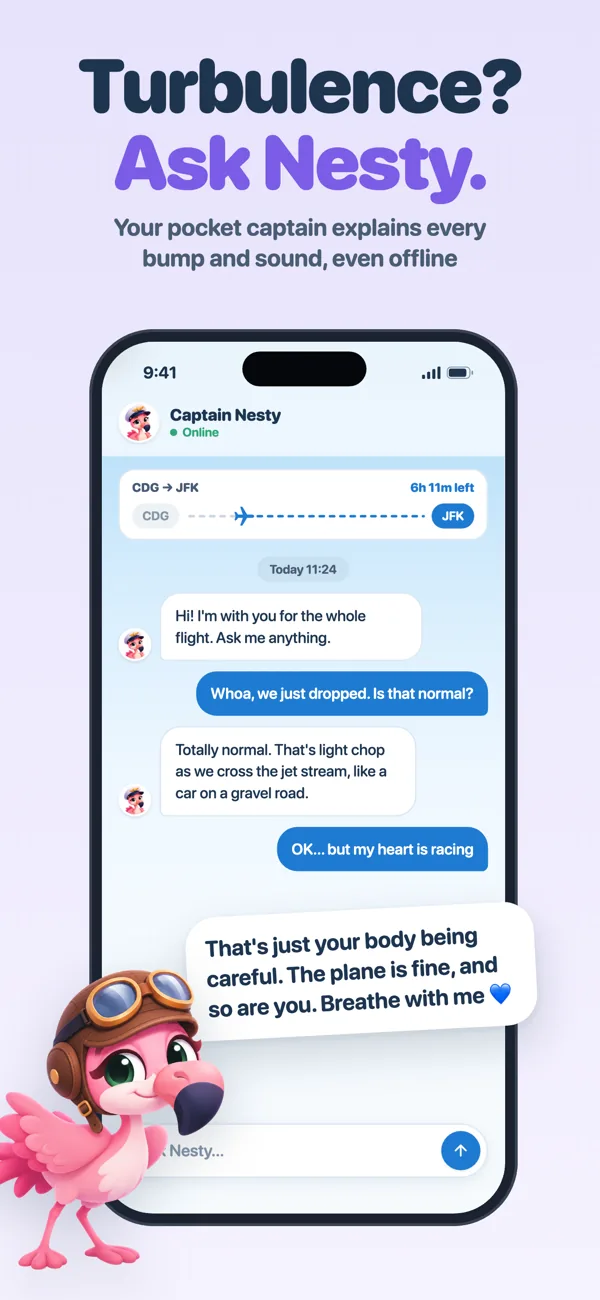
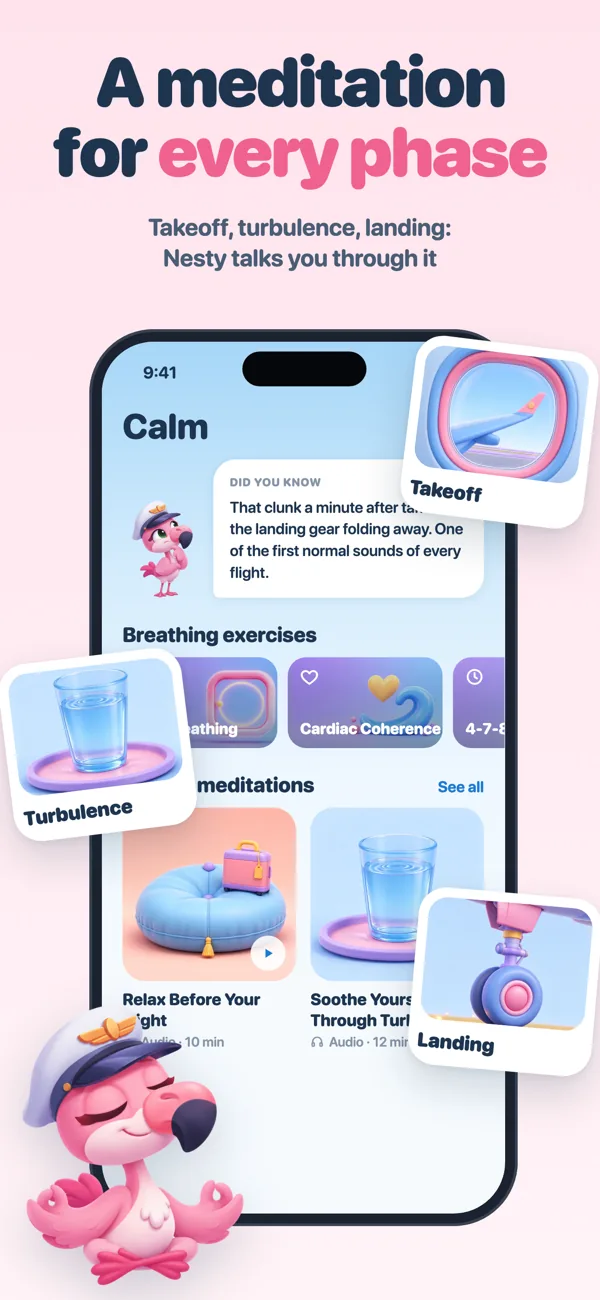
FlyNest isn't a book, and it doesn't replace one. A book prepares you at home. FlyNest is for the part a book can't come along for: the flight itself, when you can't turn pages and think at the same time. Before you go, a pre-flight plan walks you through the days ahead. On board, you can ask Nesty, the pocket captain, "what was that noise?", follow your flight on a map that works offline and play a guided meditation for takeoff, turbulence or landing.
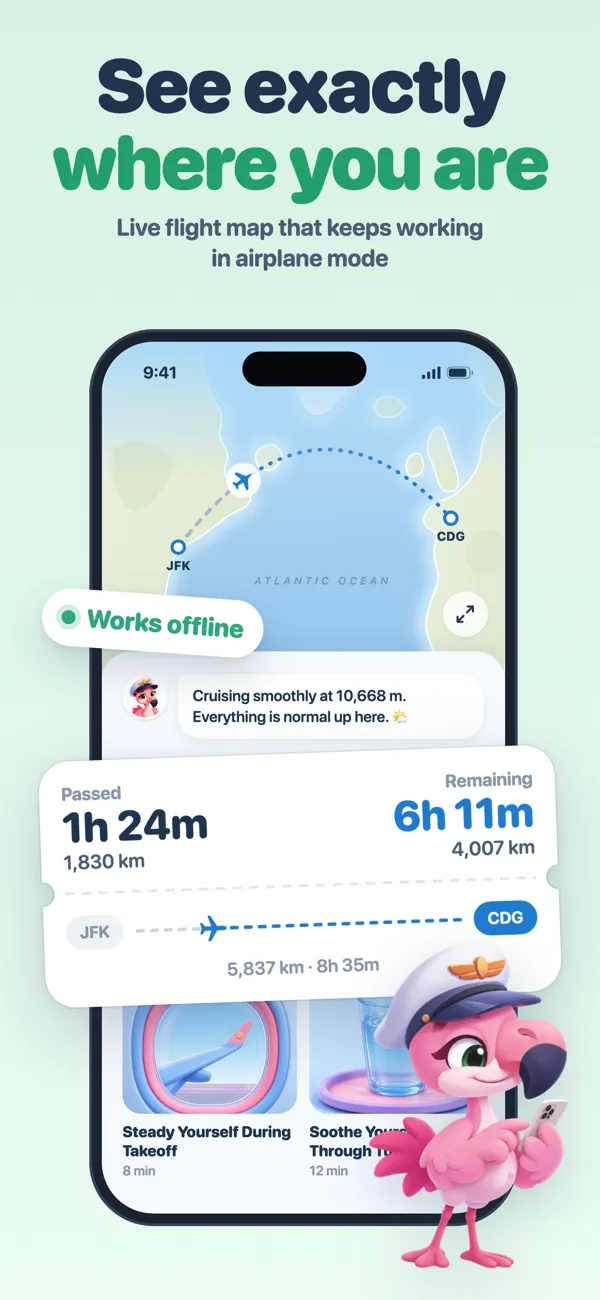
- Who it suits: readers who have learned the facts and want the same calm voice in their pocket on the day.
- Limits: no therapist and no long-form program. It's on the App Store and Google Play, by subscription.
- Free to try on the web: our turbulence forecast for any route.
How to choose
- Facts calm you down: start with Cockpit Confidential, then read what causes turbulence and what are the chances of a plane crash?.
- You want a plan to follow: the Fear of Flying Workbook, one exercise at a time.
- You've tried CBT before: Fly Away Fear, written for that situation.
- You feel trapped more than unsafe: SOAR.
- You'd rather have guidance from people than pages: see the best fear of flying courses, many of which end on a real flight.
- Your flight is tomorrow: a book is a lot to start tonight. Read flying tomorrow and panicking instead, and keep the book for the trip home.
Frequently asked questions
What is the best book for fear of flying?
It depends on what scares you. For understanding how flying works, Cockpit Confidential by Patrick Smith. For exercises you can practise, the Fear of Flying Workbook by David Carbonell. For a short, recent book by two clinical psychologists, one of them a pilot, Fly Away Fear (second edition, 2026).
Can a book cure fear of flying?
A book can help a lot, especially when it explains what happens on a flight and teaches you skills to practise. But fear of flying is a phobia, and for severe fear the NHS lists talking therapies such as CBT as a treatment. Many people use a book alongside a course or a therapist.
Is the novel Fear of Flying a self-help book?
No. The well-known 1973 novel with that title is fiction, not a guide to flight anxiety. If you are looking for help with fear of flying, the books above are the ones written for it.
Are fear of flying books based on real therapy?
Several are. The Fear of Flying Workbook draws on exposure therapy, ACT and CBT, according to its publisher, and Fly Away Fear is based on newer developments of CBT. Cockpit Confidential is different: it calms through facts about aviation rather than therapy exercises.
Should I read a book or use an app?
They do different jobs. A book teaches you at home, at your own pace. An app like FlyNest stays with you on the plane, offline, when you need a quick answer about a noise or a breathing exercise. Many nervous flyers use both.
Sources
- Fly Away Fear, 2nd edition (Routledge)
- Fear of Flying Workbook (Open Road Media, publisher's description)
- Carbonell (2017), Fear of Flying Workbook, Association for Contextual Behavioral Science
- Cockpit Confidential, second edition (Ask the Pilot)
- Flying without Fear, second edition (New Harbinger)
- SOAR, fear of flying help by Captain Tom Bunn
- NHS, Phobias
- Open Library catalogue record, SOAR (ISBN 9781493000685)
- Open Library catalogue record, Cockpit Confidential 2nd edition (ISBN 9781492663966)