Flying alone for the first time? How to feel calm when nobody's with you
Nervous about flying alone for the first time? Here is what really changes without a travel companion, a simple plan for the airport and the flight, and what to do if fear shows up mid-air.
Maybe you've flown before, but always with a parent, a partner or friends who knew where to go. Now it's just you: your bag, your boarding pass, and a small voice asking what happens if something goes wrong and there's nobody to turn to. That feeling is very common, and it usually shrinks fast once you have a plan. This page is about the part that is new when you fly solo. If it's your very first flight of any kind, start with our step-by-step guide to a first flight ever, then come back here.
Practical answer
- Write your plan down the day before: flight number, departure time, terminal, when you'll leave home and how you'll get to the airport.
- Check in online and save your boarding pass to your phone, plus a screenshot in case the app won't load.
- Arrive early. Extra time is what replaces the person who used to keep track of things for you.
- Keep your phone charged and a charger in your carry-on, not in your checked bag.
- Tell one person your flight number so they can follow along and you can text them at the gate and after landing.
- Say hello to the crew when you board, and tell them if you're a nervous flyer. They hear it often.
- Have a calming routine ready for takeoff and any bumps: slow breathing, a meditation, or questions you can ask Nesty.
What really changes when you fly alone
The flight itself is the same. The pilots, the crew, the checks and the aircraft don't change because you booked one seat instead of two. The plane is not less safe with you on your own, and the odds don't move. If the numbers help you, read the real chances of a plane crash.
What changes is three things:
- You're the one keeping track. Gates, boarding groups and times used to be someone else's job. That's a task, and tasks get easier with a list.
- There's no hand to hold. For many people, the hardest part is a bump or a noise with nobody to look at and ask "is that normal?".
- Fear can feel louder in silence. Without conversation, anxious thoughts have more room. A plan for those minutes helps more than trying not to think.
Each of these has a simple answer, and none of them needs courage you don't have.
Before you leave home
Doing the thinking at home, where you're calm, means you don't have to do it at the airport, where you might not be.
- Make a one-page plan. Flight number, departure time, airport and terminal, how you're getting there, what time you'll leave. Paper or a note on your phone both work.
- Know your security basics. In the US, the TSA asks you to follow the 3-1-1 rule for liquids in your carry-on, and its security screening page lists what to tell officers, for example if you'd like a private screening.
- Ask for support if you need it. If you have a disability or a medical condition, TSA Cares can arrange help from a Passenger Support Specialist. TSA asks you to contact them at least 72 hours before your flight. It doesn't skip screening, but it means someone trained is there to help you through it.
- Pack your carry-on for comfort: charger, headphones, a water bottle you fill after security, a snack, and something to do with your hands or eyes.
At the airport, alone
Airports are built for people who've never been there before. Everything is signposted, and staff answer the same questions all day.
- Look at the screens, not your memory. After security, find your flight number on the departures screens to confirm the gate, and check again later: gates can change.
- Go to your gate first, then relax. Once you've seen it, you can get coffee or walk around knowing exactly where you need to be.
- Ask. "Is this the line for flight 123?" is a normal question at any gate. So is "Can you tell me when my group boards?"
- If your flight is delayed or you miss a connection, go to your airline's app or desk. Rebooking is their job, not yours to solve alone, and staff deal with it every day.
On board, when there's nobody beside you
This is the part people worry about most, and it's where a little preparation pays off.
- The cabin crew are there for you too. Safety is their main job, and that includes passengers who feel unwell or frightened. You can press the call button or speak to them when the seatbelt sign is off.
- You can ask to move from an exit row. If you're seated in an emergency exit row and don't feel up to it, US rules let you ask for another seat, and the airline can't make you explain why.
- Keep your seatbelt fastened while seated. The FAA's advice on turbulence is simple: wear it whenever you're in your seat. It's also one less thing to think about if it gets bumpy.
- Give the silence a job. Choose in advance what you'll do at takeoff, in the middle of the flight and on landing: a playlist, a show, a meditation, a page of a book (our list of the best books for fear of flying has a few written for exactly this). Gaps feel shorter when they're planned.
- Breathe slowly when it gets tense. The NHS suggests breathing in gently through your nose and out through your mouth, counting to five each way, for a few minutes. It's quiet, and nobody will notice you doing it.
If fear builds into panic, you are still not stuck. Our page on what to do during a panic attack on a plane walks through it step by step. And if the nerves start the night before, read flying tomorrow and panicking.
The thoughts that come up most, and calmer answers
- "If something happens, nobody will know." The airline has a list of everyone on board, the crew are a few rows away, and the person who has your flight number can follow it on a flight tracker.
- "I'll embarrass myself." Crew see nervous flyers on almost every flight. Telling them is ordinary, not dramatic.
- "I won't know if a noise is normal." Most sounds on a flight are routine: the landing gear, flaps, engine power changing. You can look them up, or ask, before you start to worry.
How FlyNest helps
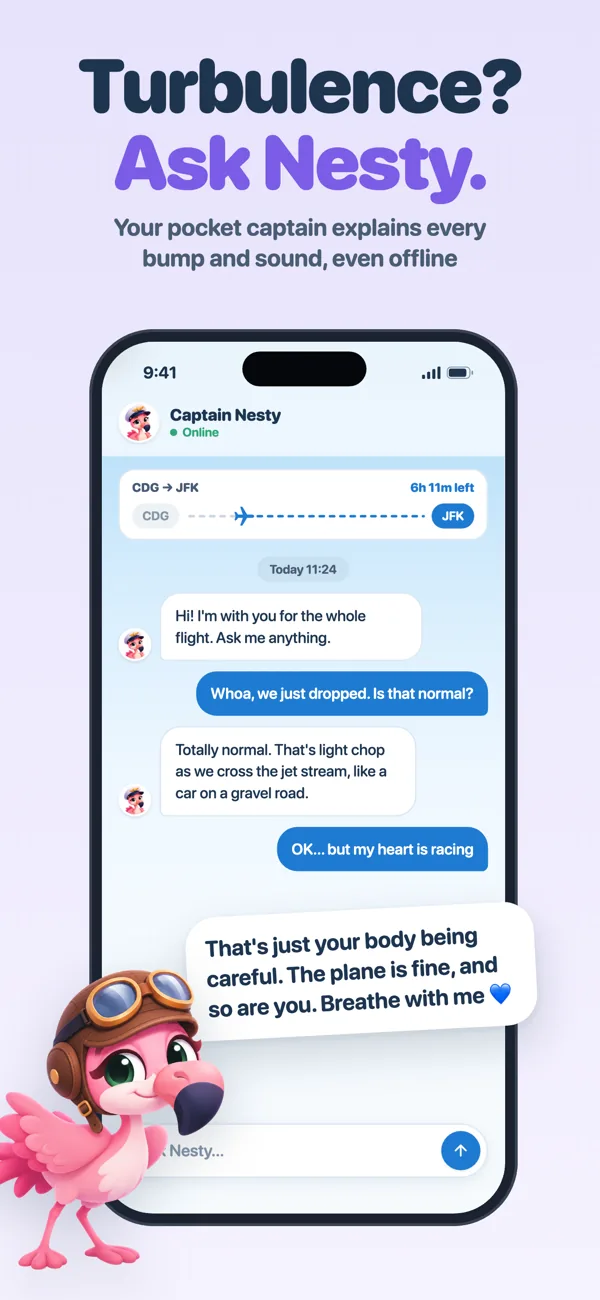
- Ask Nesty, your pocket captain, "What was that noise?" or "Is this bump normal?" and get a calm answer in seconds, so there's always something to ask. On supported devices it works offline. See Ask Nesty.
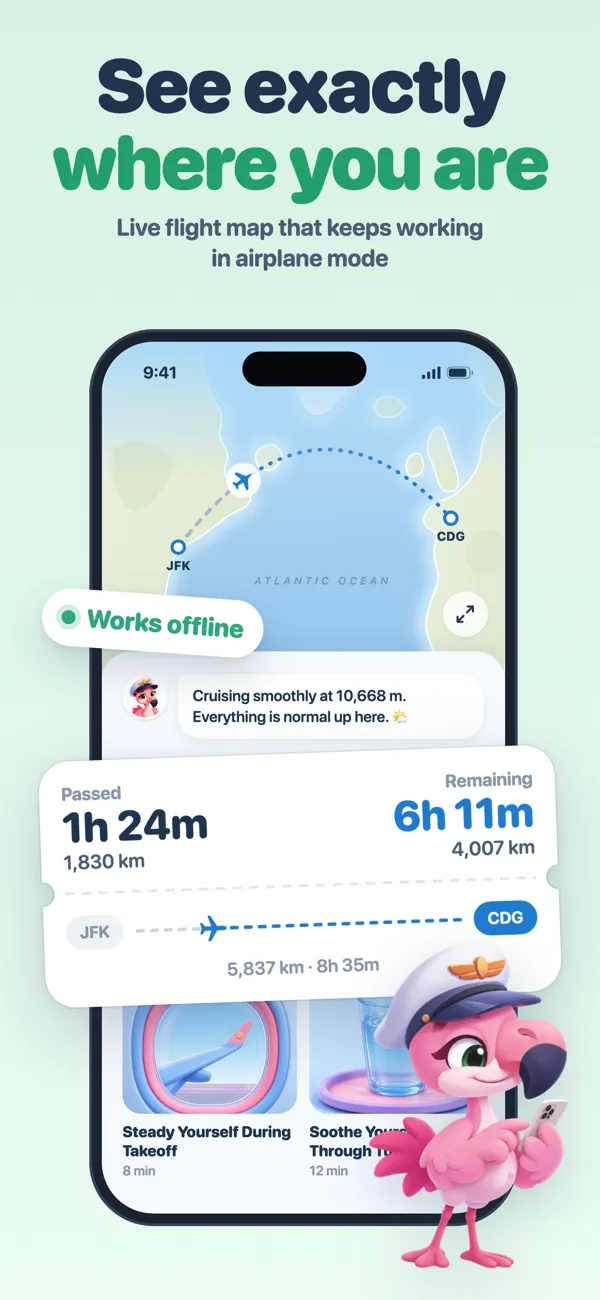
- A live map that works offline shows where you are, how long you've flown and how long is left, so the flight has a shape you can follow.
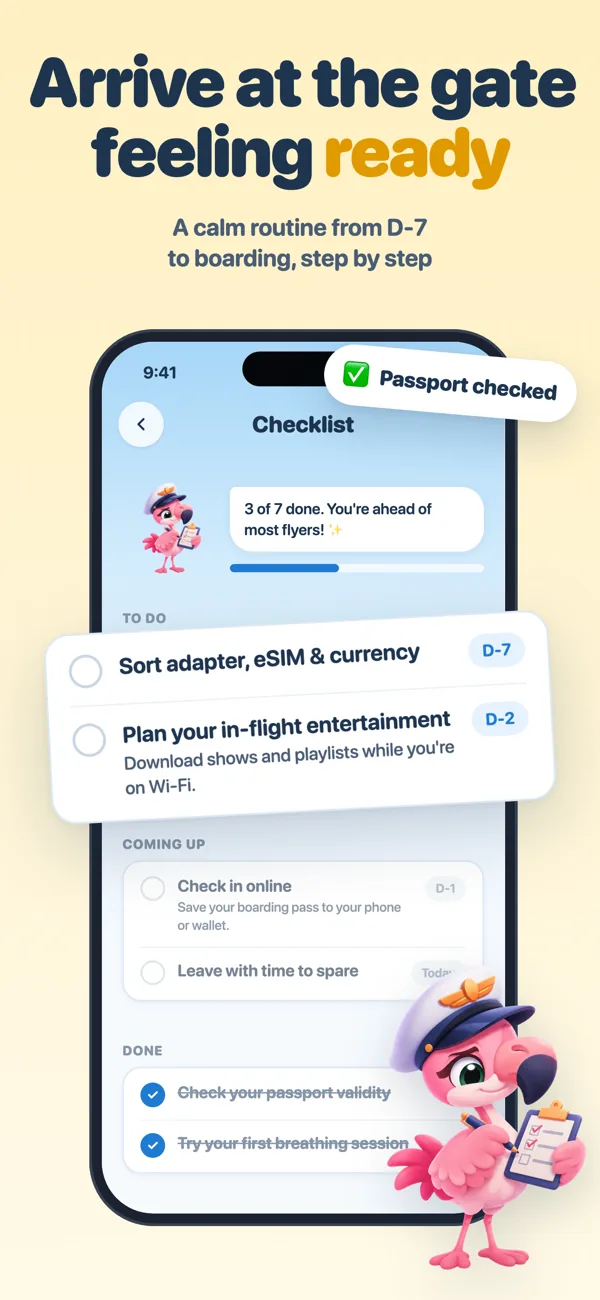
- A pre-flight plan and airport checklist for the days before, so the planning is done before you leave. See the pre-flight plan.
- Guided breathing and meditations for takeoff, turbulence and landing.
What FlyNest doesn't do
FlyNest doesn't replace the cabin crew: for anything about your own flight, your seat or how you feel physically, speak to them. It doesn't rebook flights or track delays for you, so keep your airline's app handy. And if fear of flying is stopping you from travelling at all, a doctor or therapist can really help; the NHS notes that phobias can be treated. Our guide to how therapy for fear of flying works explains the options.
Frequently asked questions
Is it normal to be scared of flying alone?
Yes. Many people who fly calmly with someone else feel nervous alone, because the companion was quietly doing part of the work: keeping track, answering "is that normal?", and talking through the quiet parts. A plan and a few tools can take over that role.
What should I do first when I get to the airport alone?
Check in or drop your bag if you have one, go through security, then find your flight on the departures screens and walk to your gate. Once you've seen the gate, the rest of the time is yours.
Can I tell the flight attendants I'm a nervous flyer?
Yes. Say it when you board or when they come by. They can tell you what to expect and check on you during the flight. It's a common request.
What if I'm seated in an exit row and don't want to be?
Tell a flight attendant. Under US rules, a passenger who doesn't want to take on the exit-row duties can ask to be moved, and the airline can't require you to give a reason.
What if I panic on the plane with nobody with me?
Slow your breathing, keep your feet flat on the floor, and remind yourself that panic rises and then eases. You can also call a flight attendant. Our panic attack on a plane page has a full step-by-step plan.