
Scared of flying over the ocean: what keeps you safe out there
Hours of open water below can feel like being far from help. Here is how ocean flights are planned: diversion airports within a set flying time, two of every key system, extra fuel, and what the life vest briefing really means.
The coast slips away behind the wing, and then for hours there is nothing below but grey-blue water. If part of you keeps thinking "there's nowhere to land out here", you're not alone, and the thought makes sense: on land, help feels close. Here is the calm truth: ocean routes are planned around exactly that worry. Before the flight leaves, the route is built so that a suitable airport stays within a set flying time, the plane carries two of the systems that matter most, and the fuel covers the worst case, not the average one.
Practical answer
- In the US rules, a twin-engine airliner may not fly a route more than 60 minutes from an adequate airport (at one-engine cruise speed) unless the FAA has approved it for longer "ETOPS" operations.
- ETOPS approval comes in set steps, each with its own reliability, maintenance and planning rules, up to 180 minutes in the FAA appendix that governs it.
- For ETOPS flights, the plane must carry enough fuel to reach a diversion airport even if it loses an engine or cabin pressure at the worst point of the route.
- Over water, the plane needs two independent long-range navigation systems and two independent long-range radios, so the crew can talk to someone from any point on the route.
- The life vest briefing is required on every overwater flight. It is a rule, not a sign that anything is expected to go wrong.
Why the ocean feels so much scarier
Over land, you can see towns, roads and fields. Your mind quietly files them as "places we could go". Over the ocean that picture disappears, and the brain fills the blank with the worst image it has. Hours of sameness don't help either: there is little to look at, the cabin is dim, and a quiet mind has more room to worry.
None of that is a sign that you are weak or silly. It is a normal reaction to a situation where you can't see the safety nets. The rest of this page shows you where they are, so the blank below the wing has something real in it.
The rule that keeps an airport within reach
The key rule is 14 CFR 121.161. It says that, unless approved under Appendix P and the airline's operations specifications, no US airline may fly a turbine airliner over a route with a point farther than 60 minutes from an adequate airport for a two-engine airplane, or 180 minutes for a passenger airplane with more than two engines. That time is measured at the speed the plane would fly on one engine, in still air.
Flying farther than that is called ETOPS. The FAA's definitions describe it as a flight where part of the route lies beyond that time threshold. Pilots and dispatchers plan it on purpose: the route is drawn between chosen alternate airports, islands and coastal fields, so one is always within the approved time.
Appendix P sets out how the FAA grants that approval, in steps of 75, 90, 120 and 180 minutes. Before granting it, the FAA requires the airline to show the engine reliability set for that airplane and engine pair, and afterwards to keep monitoring it. Each step adds conditions on maintenance, on the equipment list the plane must have working, and on planning. In plain words: the longer the route may take the plane from an airport, the more is checked before it goes.
Over the ocean, the plane is not "on its own". It is flying a line that was drawn so a runway is always within reach.
Fuel for the worst moment, not the average one
A common thought is "what if something happens halfway?". The fuel rules answer that question directly.
For every flag flight outside the US, 14 CFR 121.645 already requires enough fuel to reach the destination, then to fly for a further 10 percent of the trip time, then to reach an alternate airport and hold there.
For ETOPS flights, 14 CFR 121.646 adds a separate check. The plane must carry enough fuel to fly to an ETOPS alternate airport assuming, at the most critical point of the route:
- a rapid loss of cabin pressure and a descent to a lower, safe altitude, or
- a loss of cabin pressure and an engine failure at the same time, or
- an engine failure and a descent to the one-engine cruise altitude,
whichever needs the most fuel. The same rule tells airlines to add 5 percent to the forecast winds, in case the forecast is wrong. Most flights never use any of that margin. It is there so the hardest version of "halfway" is already planned.
Two of everything you'd worry about
Far from land, the usual radio stations are out of range. So 14 CFR 121.351 says an extended over-water flight needs at least two independent long-range navigation systems and two independent long-range communication systems. Together they must let the crew talk to at least one station from any point on the route and receive weather from any point on the route. At least one must carry two-way voice.
"Extended over-water" has a precise meaning too: more than 50 nautical miles from the nearest shoreline, according to the FAA definitions. So on a long ocean crossing the crew is still in contact, still and still receiving weather.
If you hear a different sound during the long quiet cruise, it is usually one of the normal sounds of flight. Our page on airplane noises during a flight explains them one by one.
What the life vest briefing really means
On an ocean flight, the safety video spends time on life vests and rafts. For a nervous flyer that can sound like a warning. It isn't.
14 CFR 121.573 requires every passenger on an extended overwater flight to be briefed on the location and use of life preservers, liferafts and other flotation, including how to put on and inflate a life vest. If the plane heads over water right after takeoff, the briefing happens before takeoff; otherwise it must be given before the overwater part begins. It is the same on every such flight, whatever the weather or the aircraft.
The equipment itself is required by 14 CFR 121.339: a life preserver with a locator light for each person on board, enough life rafts for everyone even if the largest raft is lost, signalling devices, and a survival emergency locator transmitter. And under 121.161, a US airline may only fly a land airplane (apart from a few old types) on such routes if it is certificated or approved as adequate for ditching under the airliner design rules. Those rules require the plane to be designed so that, in reasonably probable water conditions, it floats long enough, at a stable enough angle, for everyone to get out and into the rafts.
The briefing is the way the rules make sure everyone knows where the equipment is. Watching it is a calm, practical thing to do, then you can put the thought away.
Can a plane really land on water?
Airliners are designed and tested for it, as above, and it is extremely rare. The best-known case is US Airways Flight 1549 in January 2009. After a flock of birds took out both engines shortly after takeoff from LaGuardia, the crew put the A320 down on the Hudson River. The NTSB report records that all 150 passengers, including a lap-held child, and the 5 crew members got out through the forward and overwing exits. Four passengers and one flight attendant were seriously injured.
That flight was over a river near New York, not an ocean, and it is remembered precisely because it is so unusual. For the overall picture of how rare serious accidents are, see the chances of a plane crash.
What helps during a long water crossing
- Watch the safety briefing once, calmly. Find your life vest and the nearest exit, then let it go. Knowing is calmer than guessing.
- Look at the map, not the window. The window shows only water. A flight map shows the plane moving steadily along its line, with the coast ahead getting closer.
- Give the hours a shape. Meal, a film, a nap, a walk to stretch. Long, flat time is where worry grows.
- Breathe slowly and steadily. The NHS suggests slow breaths in through the nose and out through the mouth, counting to keep a steady rhythm. A few minutes of this tells the body it is safe.
- Expect a bump or two. Long ocean flights often cross jet streams, so a bumpy patch is normal. Our page on turbulence on long-haul flights explains why it is safe.
Still scared as the coast disappears? That's allowed: our page for people who are scared to fly and going anyway is about doing the flight without waiting to feel calm.
Crossing with someone who is more nervous than you are? Our page on how to help someone with a fear of flying covers what to say, and what to do in the seat beside them.
How FlyNest helps
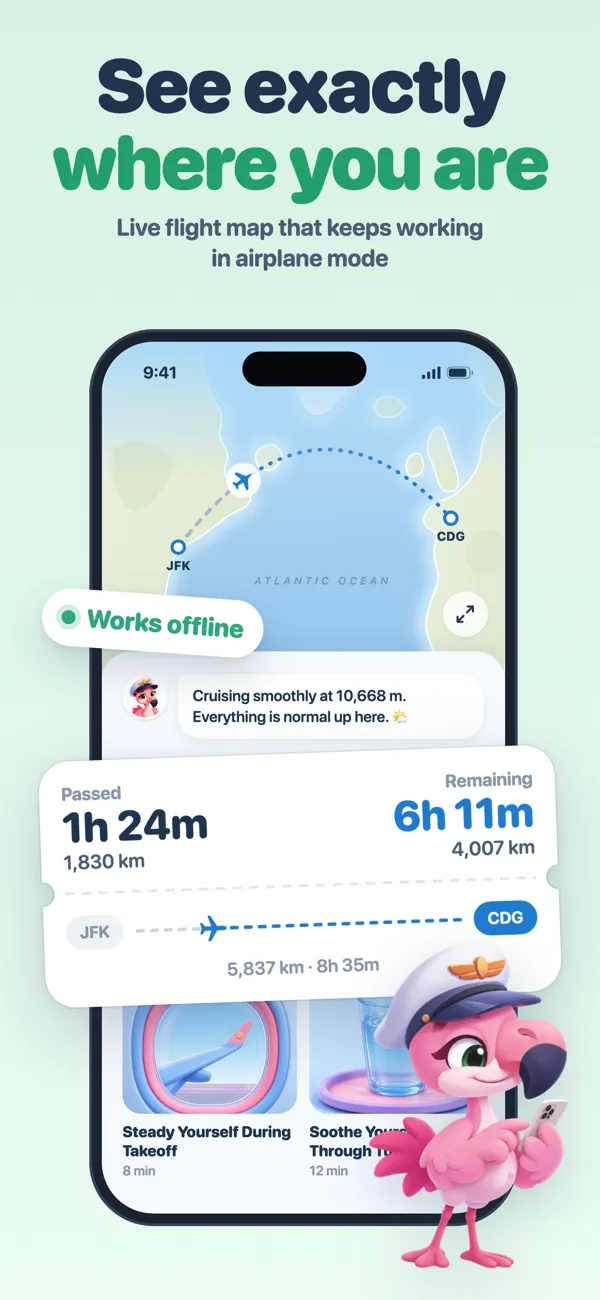
- A live flight map that works offline, so you can watch the plane cross the ocean and count down the time to the next coast, without paying for wifi. See the live flight map.
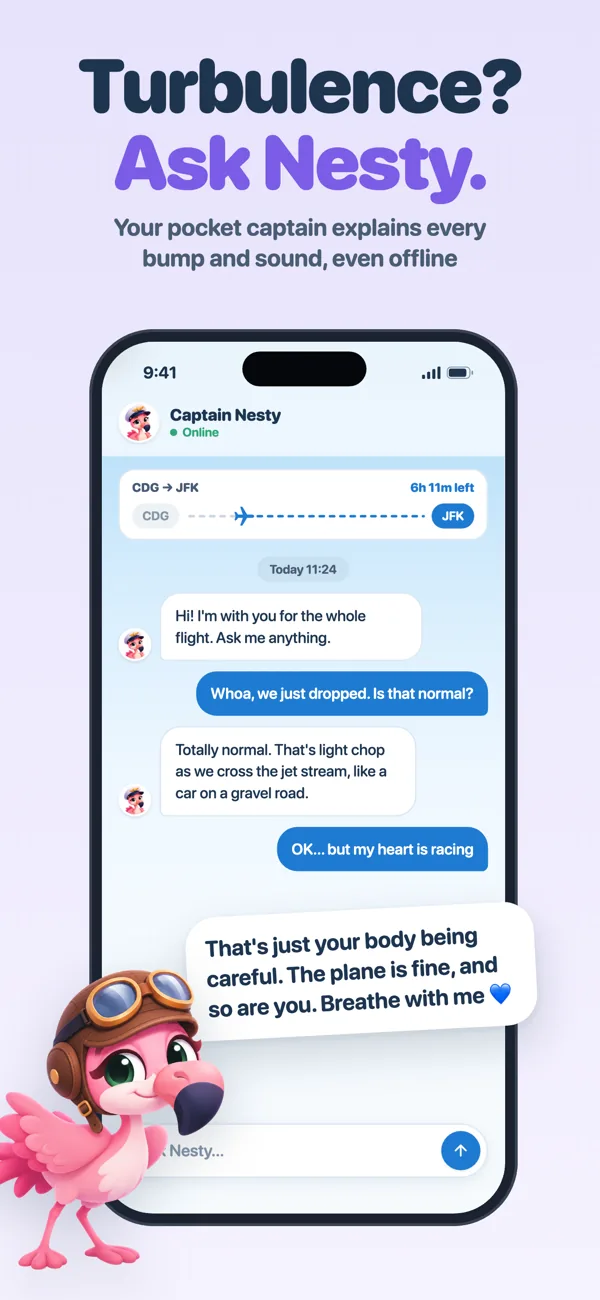
- Ask Nesty "What happens if something goes wrong over the ocean?" and get a calm, plain-language answer about diversion airports and planning. See Ask Nesty, your pocket captain.
- Guided breathing and meditations for the long, quiet hours of cruise. See breathing exercises for flying.
- A "You made it!" moment after landing, so the crossing is remembered as one you got through.
What FlyNest doesn't do
FlyNest doesn't know which diversion airports your airline planned for today, and it can't see the aircraft's systems or hear the crew's radio calls. Your crew's announcements are always the official word. FlyNest helps you understand what's normal and calm your body during the crossing. If fear of flying is limiting your life, talking to a doctor or a therapist can really help.
Frequently asked questions
Is it safe to fly over the ocean?
Yes. Ocean routes are planned so a suitable airport stays within an approved flying time, with extra fuel for the worst case and two long-range radios and navigation systems on board. These rules exist precisely because there is water below.
What happens if a plane has a problem over the ocean?
The crew follows a plan made before departure: the route lists diversion airports, and the fuel was calculated so the plane can reach one even after an engine failure or a loss of cabin pressure at the most critical point.
How far from an airport can a plane fly over the ocean?
Under US rules, a twin-engine airliner without ETOPS approval must stay within 60 minutes of an adequate airport at one-engine cruise speed. With ETOPS approval, the FAA allows longer times in steps such as 120 or 180 minutes, each with extra conditions.
Why do they show the life vest on ocean flights?
Because the rules require that briefing on every extended overwater flight, before the plane reaches open water. It is routine, like showing the exits, and it doesn't mean anything is expected to happen.
Can a plane land on water safely?
Airliners flown on these routes must be approved as adequate for ditching, which means designed to float long enough for everyone to get out. It is extremely rare. On US Airways Flight 1549 in 2009, all 155 people on board got out after the crew landed on the Hudson River.
Is turbulence worse over the ocean?
It can be bumpier at times, because long ocean routes often cross jet streams, but turbulence over water is no more dangerous than over land. The plane is built for it, and keeping your seat belt fastened is the main thing to do.
Sources
- 14 CFR 121.161, Airplane limitations: type of route
- 14 CFR Part 121, Appendix P: Requirements for ETOPS and Polar Operations
- 14 CFR 1.1, General definitions (ETOPS, extended over-water operation)
- 14 CFR 121.646, En-route fuel supply: flag and supplemental operations
- 14 CFR 121.645, Fuel supply: flag, supplemental and certain domestic operations
- 14 CFR 121.351, Communication and navigation equipment for extended over-water operations
- 14 CFR 121.339, Emergency equipment for extended over-water operations
- 14 CFR 121.573, Briefing passengers: extended overwater operations
- 14 CFR 25.801, Ditching
- NTSB, Aircraft Accident Report AAR-10/03, US Airways Flight 1549 ditching on the Hudson River
- NHS, Breathing exercises for stress