
My plane is circling before landing: what a holding pattern means
Your plane should be landing, but it keeps turning in wide loops. That's a holding pattern, a routine queue in the sky. Here is why air traffic control uses it, what you feel, and why fuel for it is planned before takeoff.
The flight map said you were nearly there. Then the plane leaned into a long, slow turn, straightened out, and turned again. Ten minutes later you are still not landing. If you're reading this in your seat, here is the most important thing: a plane circling before landing is almost always in a holding pattern, a routine way for air traffic control to make planes wait their turn. It is planned for, and the crew knows exactly where they are.
Practical answer
- A holding pattern is a racetrack-shaped loop that keeps a plane inside a protected piece of sky while it waits for permission to continue.
- The FAA says controllers assign holds for reasons such as bad weather at the airport or a lot of traffic arriving at once.
- Each lap is short and gentle: two straight legs and two smooth half-circle turns.
- Airlines must carry fuel for delays like this. In the US, the rules require enough fuel to reach the destination, then an alternate airport when one is needed, then fly on for a set extra time.
- Most holds end with a normal approach and landing. Breathe out slowly, and watch the loops on a map if it helps.
What a holding pattern is
The FAA's Pilot/Controller Glossary defines it plainly: a predetermined maneuver that keeps an aircraft within a specified airspace while it waits for further clearance from air traffic control. Think of it as a waiting room with walls you can't see.
Every hold is built around a fixed point that pilots can identify on their instruments, called the holding fix. The plane flies to that point, then follows a set loop around it. According to the FAA's Aeronautical Information Manual, the standard pattern uses right turns, and the straight leg back toward the fix lasts 1 minute at or below 14,000 feet, or 1½ minutes above that. Many holds are printed on the charts pilots already carry, so the crew is often flying a shape they have seen before.
The same manual says that when a delay is expected, controllers give the crew complete holding instructions plus an "expect further clearance" time and their best estimate of any extra delay. In other words, your pilots are usually told roughly how long the wait should be. That is often what they share in the announcement.
Why planes are asked to hold
The FAA's Instrument Procedures Handbook says controllers assign holds "for a variety of reasons, including deteriorating weather or high traffic volume". It also notes that a hold can follow a missed approach, which is what pilots call a go-around, when a plane climbs away instead of landing.
In everyday terms, the most common reasons are:
- Too many planes arriving at once. A runway can only take one landing at a time, so controllers line planes up. Holding is one way to space them out.
- Weather at the airport. Storms, strong wind or low cloud can slow down how often planes can land, or close a runway for a while.
- A runway change or a short closure. When the airport switches runways or clears one, arrivals wait a few minutes.
The handbook adds that arrival delays are usually absorbed well before the airport, at a point 10,000 feet or more above it, rather than with low-level holds. So if you're circling high up, that is the system working as designed.
What you feel and hear
A hold can feel strange because you expect the plane to be heading down, and instead it seems to wander. Here is what is happening at each moment.
- The plane slows down. The FAA sets maximum speeds for holding (200, 230 or 265 knots depending on altitude), so the engines often go quieter as the plane eases back.
- A long, gentle turn. Holding turns are flown at a standard rate of 3 degrees per second, or a limited bank angle, whichever is gentler. At that rate a half-circle takes about a minute. The tilt can feel bigger than it is when you look out of the window.
- A straight stretch. About a minute of level flight, then the next turn.
- The same thing again. One lap at lower altitudes takes roughly four minutes. Several laps can feel endless, but each is identical.
- The way out. When controllers clear the plane to continue, it leaves the loop, starts descending and joins the line of arrivals. Then it lands like any other approach.
If you feel a small bump while circling, that is just the air, the same as at any other moment of the flight. Our page on turbulence anxiety explains why the body reacts so strongly to it.
What about fuel?
This is often the real fear behind the loops: "What if we run out?" Fuel for waiting is part of the plan before the plane even leaves the gate.
In the US, the rule for domestic airline flights, 14 CFR 121.639, says a plane may not take off unless it has enough fuel to fly to its destination, then to the most distant alternate airport when an alternate is required, and then to keep flying for 45 more minutes at normal cruising fuel use. For many longer international flights, 14 CFR 121.645 adds an extra 10% of the flight time, plus fuel to reach the alternate airport, plus 30 minutes of holding above it. Long flights over water add one more check on top: see what keeps you safe when flying over the ocean.
There is also a clear process if a wait starts to get long. The FAA's Aeronautical Information Manual tells pilots to report "minimum fuel" to controllers when they can't accept any undue delay at their destination. It describes this as an advisory, not an emergency. If priority is ever needed, pilots declare it, and controllers act on it. And if a hold goes on longer than planned, the crew can divert to the alternate airport, which the fuel already covers.
So your pilots are not quietly circling until the tanks are empty. They are watching the fuel against a plan, with set steps in place long before it would ever matter.
What to do in the moment
- Breathe out longer than you breathe in. The NHS breathing exercise for stress uses slow breaths in through the nose and out through the mouth, counting as you go. Our breathing exercises for flying guide you through it.
- Name what's happening: "We're in a hold. Right turn, straight leg, right turn. We're waiting our turn."
- Count the laps instead of the minutes. Each lap is the same, which makes the wait easier to hold in your head.
- Look at the cabin crew. If they are carrying on as normal, it's because holding is ordinary for them.
- If panic builds, follow the steps in what to do during a panic attack on a plane.
Why it feels worse than it is
An anxious mind treats any change from the expected script as a warning sign. You were promised a landing, and the plane is doing something else, so your body fills the gap with danger. Silence from the cockpit can make it worse, but pilots fly first and talk second: the announcement may only come once the hold is set up.
It can help to remember that holding is one of the most routine things air traffic control does. If the bigger fear is about crashes in general, our guide to the real chances of a plane crash puts the numbers in perspective, and flight anxiety explains why these thoughts stick.
How FlyNest helps
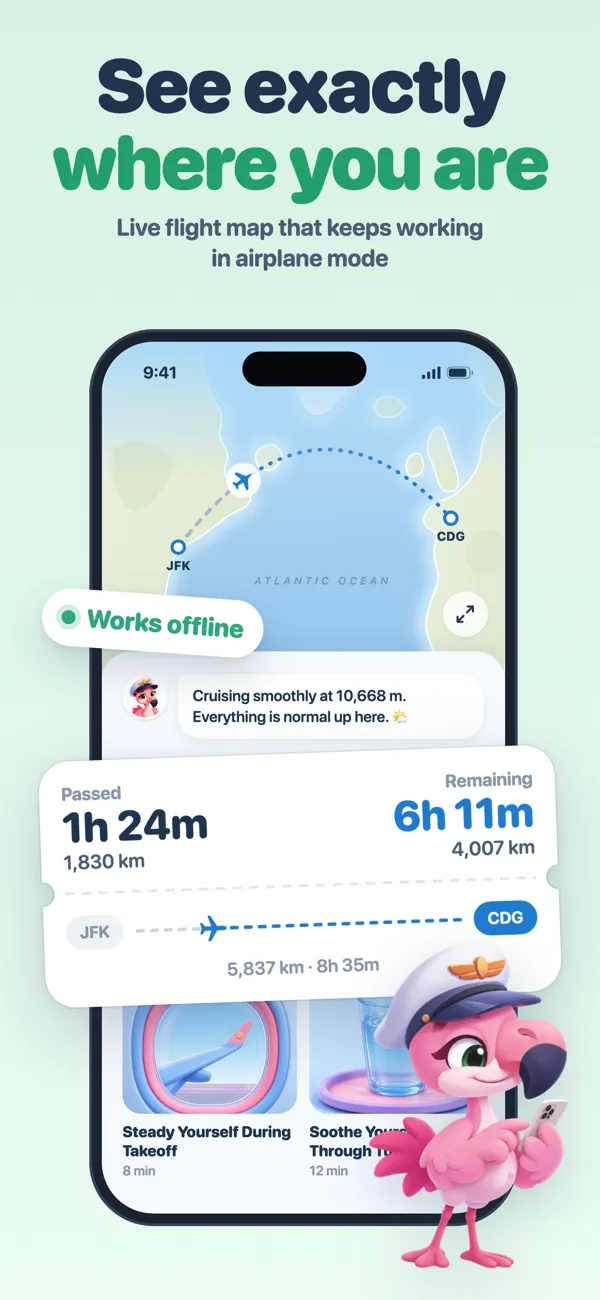
- A live flight map that works offline, so you can see the racetrack loops and the moment the plane leaves the hold, instead of imagining it. See the live flight map.
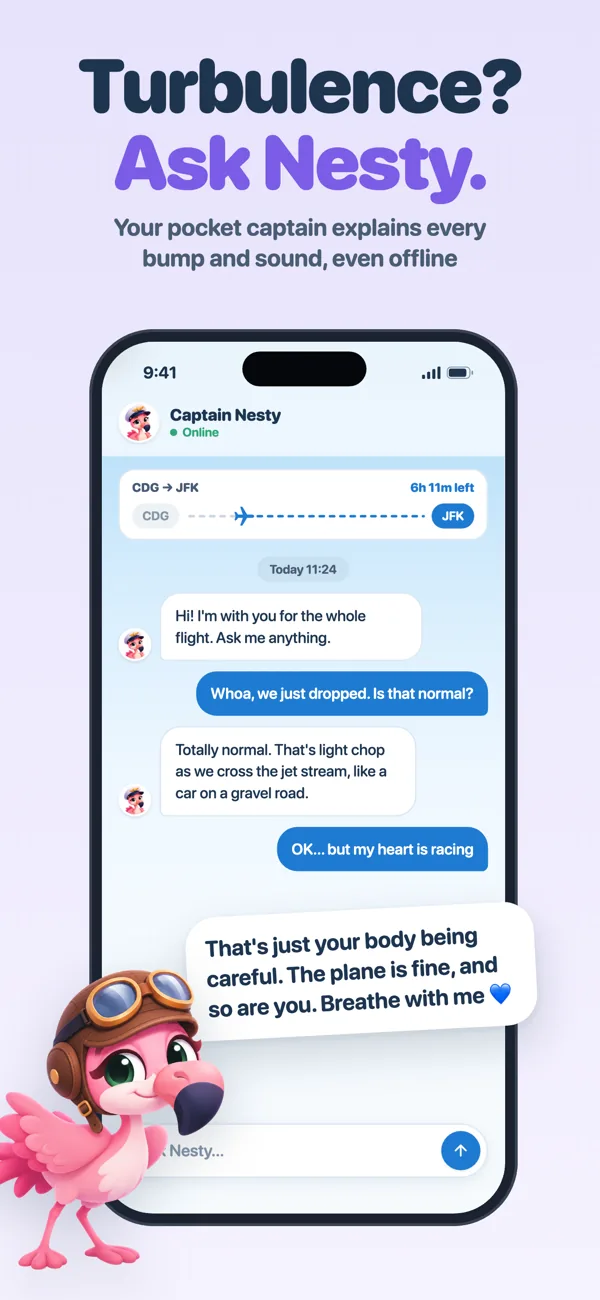
- Ask Nesty "Why are we circling?" and get a calm, plain-language answer about holding patterns. See Ask Nesty, your pocket captain.
- Guided breathing and meditations for landing, for the minutes while you wait for the approach.
- A "You made it!" moment after touchdown, so the flight is remembered as one you got through.
What FlyNest doesn't do
FlyNest can't tell you why your flight is holding or how long it will last, and it doesn't hear what air traffic control tells your pilots. Your crew's announcement is always the official word. FlyNest helps you understand what's normal and calm your body while you wait. If fear of flying is affecting your life, talking to a doctor or a therapist can really help.
Frequently asked questions
Why is my plane circling before landing?
Most often it is in a holding pattern: air traffic control has asked it to wait, usually because of traffic or weather at the airport. The plane flies a set loop until it is cleared to continue.
Is a holding pattern dangerous?
No. It is a standard procedure written into FAA rules and charts, and pilots train for it. Each hold sits in protected airspace, and each plane flies at the altitude it was assigned.
How long can a plane stay in a holding pattern?
It depends on the delay and the fuel plan. Controllers give pilots an expected time to leave the hold, and airlines carry extra fuel for delays. If the wait grows too long, the crew diverts to an alternate airport.
Can a plane run out of fuel while circling?
Fuel for delays and for reaching another airport is planned before takeoff. Pilots tell controllers early if they can't accept more delay, and they can divert long before fuel becomes a concern.
Why didn't the pilot say anything at first?
Setting up a hold keeps the crew busy with navigation and radio calls. Pilots fly first and talk second, so the announcement often comes a few minutes later.
Sources
- FAA, Aeronautical Information Manual, Chapter 5 Section 3 (5-3-8 Holding)
- FAA, Aeronautical Information Manual, Chapter 5 Section 5 (5-5-15 Minimum Fuel Advisory)
- FAA, Instrument Procedures Handbook (FAA-H-8083-16B), Chapter 3: Arrivals
- FAA, Pilot/Controller Glossary (H)
- 14 CFR 121.639, Fuel supply: all domestic operations
- 14 CFR 121.645, Fuel supply: turbine-engine powered airplanes, other than turbo propeller: flag, supplemental, and certain domestic operations
- NHS, Breathing exercises for stress