
The plane suddenly dropped: what an "air pocket" really is
Your stomach lifted, a few people gasped, and it felt like the plane fell. There is no hole in the sky. Here is what an "air pocket" really is, how far planes actually move, and what to do when it happens.

Your stomach lifted, your drink jumped, someone behind you gasped, and for a second it felt like the plane simply fell. If you're reading this in your seat, or replaying it after landing, start here: the air didn't vanish under the plane, and the plane didn't fall out of the sky. It flew through moving air, the way a boat rides a wave, and the wings kept working the whole time.
Practical answer
- An "air pocket" isn't a hole in the sky. It's the everyday name for a downdraft or a sudden change in the wind: air that is sinking or shifting, not air that is missing.
- In the FAA's own turbulence scale, even moderate turbulence means the aircraft "remains in positive control at all times". The drop you felt is usually a short change in height, then the plane settles.
- Your inner ear senses acceleration, not distance, so a short dip feels much bigger than it is. That's why it feels like falling.
- The only thing that turns a drop into an injury is being unbelted. Keep your seatbelt fastened whenever you're seated, even when the sign is off.
- What to do right now: belt on, long breath out, look at the crew. They're the best gauge of what's normal.
Is an air pocket real?
The phrase is old and vivid, but you won't find it in the way pilots describe turbulence. The FAA's Aeronautical Information Manual, the reference for how pilots report bumps to each other, grades turbulence as light, moderate, severe or extreme, by how the aircraft and the people inside react. The only "air pockets" in that chapter are the bubbles trapped in ice.
What people call an air pocket is one of a few real, ordinary things:
- Sinking air. The FAA's Aviation Weather Handbook explains that when air is heated and rises, "for every rising current, there is a compensating downward current". Fly from rising air into sinking air and the plane moves down with it for a moment.
- A gust or a change in wind. A sudden change in the speed or direction of the wind changes how much lift the wings make for a second or two.
- Clear-air turbulence near the jet stream, which you can't see. See clear-air turbulence explained.
- Mountain waves. Strong wind crossing a mountain range ripples downstream, and the plane rises and sinks with it. See mountain wave turbulence.
In every case there is air under the wings, and the wings are still flying. The plane is being nudged by moving air, not dropping through empty space.
How far does the plane really drop?
Much less than it feels. The FAA's scale describes it this way:
| Turbulence | What the plane does | What you feel in the cabin |
|---|---|---|
| Light | Slight, erratic changes in height or attitude, or rhythmic bumpiness | A slight strain against your seatbelt; walking and food service are easy |
| Moderate | Changes in height or attitude, but the aircraft remains in positive control at all times | Definite strain against your belt; loose objects move; walking is difficult |
| Severe | Large, abrupt changes in height or attitude; may be momentarily out of control | Pushed hard against your belt; loose objects tossed about; walking impossible |
Most of the drops people remember are light or moderate. Severe turbulence is rare, and pilots work to stay away from it using forecasts and reports from aircraft ahead.
To put a real number on "huge", take one of the most violent turbulence events of recent years, Singapore Airlines flight SQ321 in May 2024. Singapore's investigators found that during the worst 4.6 seconds the aircraft lost 178 feet of altitude, from 37,362 to 37,184 feet (TSIB preliminary findings). That event injured people who were not belted, and it was terrifying for everyone on board. Even there, the drop was 178 feet, about 54 metres, at 37,000 feet. The pilots were back at their cruising altitude within a minute and landed in Bangkok. We go through it in detail in can turbulence cause a plane crash?.
Why it feels like falling
The FAA's spatial disorientation brochure, written for pilots, explains that the inner ear holds small organs that sense changes in linear acceleration and gravity, and that when what you feel doesn't match what you see, the brain is easily fooled.
In a cabin, you can't see the ground and the walls move with you. So when the plane briefly accelerates downward, your inner ear reports the acceleration loud and clear, and your eyes have nothing to measure it against. Your brain fills the gap with the worst case: falling. A short dip reads as a long drop. That lurch in your stomach is real, but it measures how quickly the motion changed, not how far you went.
If that sensation sets off panic, you're not overreacting. Your body is doing exactly what it was built to do. Read why turbulence triggers anxiety for what's happening and how to work with it.
Why the plane is fine
- It's built for much worse. US certification rules (14 CFR 25.341) require airliners to be designed for strong vertical and lateral gusts, and for continuous turbulence. The structure also has to handle loads of at least 2.5 g in manoeuvres (14 CFR 25.337), with a further safety margin on top.
- Pilots ride it, they don't fight it. The Aviation Weather Handbook notes that forcing a plane to hold an exact altitude in strong turbulence adds stress, and that stresses are least when its attitude is held steady. So a plane that gives a little height and then takes it back is being flown sensibly.
- The crew expected it. Before departure, pilots review the turbulence forecast for the route, and in flight they hear reports from aircraft ahead. A "please return to your seats" is usually a plan, not a reaction. You can see what they saw with our free turbulence forecast.
What to do when the plane drops
- Check your belt. Low and snug across your hips. This is the one thing that really protects you; the FAA's advice to passengers is to keep it fastened whenever you're seated (FAA: Turbulence, staying safe).
- Breathe out slowly, longer than you breathe in. A long exhale tells your body the danger has passed. Our breathing exercises for flying walk you through it.
- Name it: "That was a downdraft. There's air under the wings. The plane is in control."
- Look at the crew. Their calm is information. If they keep going about their work, the plane is behaving normally.
- Loosen your grip. Drop your shoulders, unclench your jaw, put your feet flat on the floor. A braced body keeps the alarm going.
- If panic builds, follow the steps in what to do during a panic attack on a plane.
On your next flight, a seat over the wings usually feels the motion least: see the best seat for turbulence.
How FlyNest helps
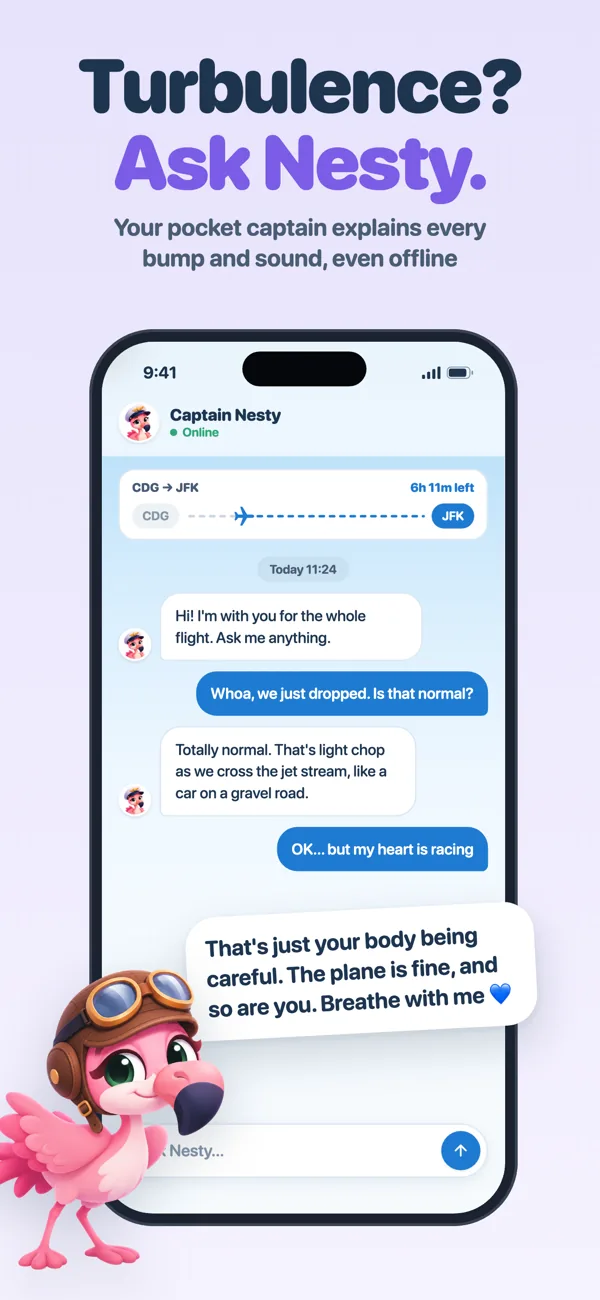
- Ask Nesty "We just dropped, is that normal?" and get a calm, plain answer in seconds, even offline on supported devices. See Ask Nesty, your pocket captain.
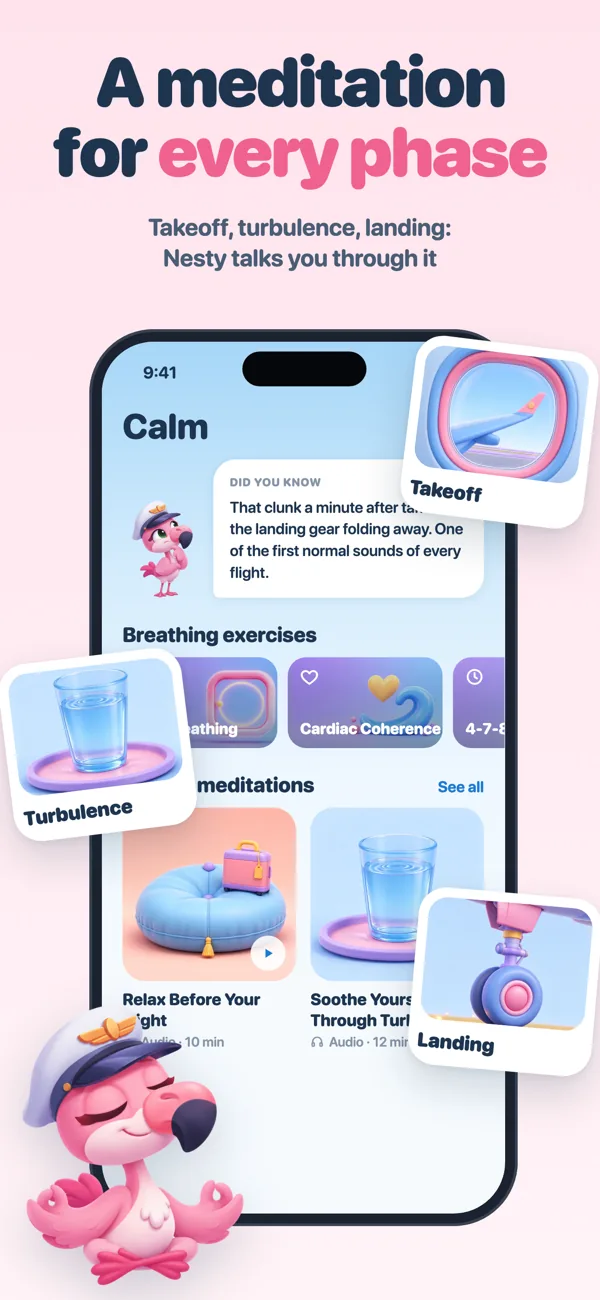
- A meditation for turbulence and guided breathing for the bumpy minutes.
- A live flight map that keeps working in airplane mode, so you can see the plane still moving forward on its route.
- A library of short reads about bumps, sounds and safety, so the next drop has a name before it happens.
What FlyNest doesn't do
FlyNest can't feel the air ahead of your plane or tell you exactly when the next bump will come, and it doesn't replace the crew's instructions: when the seatbelt sign comes on, follow it. FlyNest helps you understand what's normal and calm your body while it happens. If fear of flying is shaping your life, a doctor or therapist can really help; see how therapy for fear of flying works.
Frequently asked questions
Are air pockets real?
Not as holes in the sky. "Air pocket" is the everyday name for a downdraft or a sudden change in the wind. The air is moving, not missing, and the wings keep producing lift the whole time. Pilots describe these moments as light, moderate or severe turbulence.
How far does a plane drop in an air pocket?
Usually far less than it feels. In light and moderate turbulence, the FAA describes changes in height with the aircraft in positive control at all times. In SQ321, one of the most violent recent events, investigators measured a drop of 178 feet over 4.6 seconds, at 37,000 feet.
Why does my stomach drop during turbulence?
Your inner ear senses changes in acceleration, not distance. When the plane briefly accelerates downward and you can't see the ground, your brain reads it as falling. The sensation is real, but it exaggerates how far the plane moved.
Can an air pocket make a plane crash?
Airliners are designed for strong gusts and continuous turbulence, with a safety margin on top, and pilots avoid the worst areas using forecasts and reports. The real risk in a sudden drop is to people who aren't belted, which is why the crew asks you to keep your seatbelt fastened.
What does moderate turbulence feel like?
You feel a definite pull against your seatbelt, loose objects can move, and walking down the aisle is difficult. It can feel dramatic, but by the FAA's definition the aircraft remains in positive control at all times.
Sources
- FAA, Aeronautical Information Manual, Chapter 7 Section 1 (Turbulence Reporting Criteria)
- FAA, Aviation Weather Handbook (FAA-H-8083-28B), Chapter 19 Turbulence
- FAA, Spatial Disorientation (pilot safety brochure)
- FAA, Turbulence: staying safe
- Singapore Ministry of Transport, TSIB preliminary findings on SQ321 (29 May 2024)
- eCFR, 14 CFR 25.341 Gust and turbulence loads
- eCFR, 14 CFR 25.337 Limit maneuvering load factors