
Scared of flying on a small plane? What the numbers really say
Small plane, regional turboprop or private jet: the risk depends far more on who operates the flight than on the size of the aircraft. Here are the US figures, and how to tell which kind of flight you're on.
You booked a trip and the last leg is a turboprop. Or you're going to an island on a nine-seater, or a friend has offered you a seat on a private plane. Walking across the tarmac and seeing how small it is can be harder than any big jet. That reaction makes sense. Here's what is true, including the parts that aren't entirely comforting, because you deserve real numbers and not just "you'll be fine".
Practical answer
- Size is the wrong question. The rules the flight operates under matter more. A small aircraft sold as an airline flight is very different from a private flight in a similar-sized aircraft.
- A scheduled flight on a jet, or on anything with more than 9 passenger seats, flies under the US airline rule book (Part 121). That covers nearly every regional jet and regional turboprop.
- Charter and private flying are not at the airline level. In 2024, US airlines had no fatal accidents, charter had 0.14 per 100,000 flight hours, and general aviation had 0.72.
- You'll feel more on a small plane, and that isn't a sign of more danger. The FAA notes that the effect of turbulence varies with the size of the aircraft.
- For a charter, you can check the operator on the FAA's list of authorized companies.
Which kind of small plane are you on?
This changes the whole answer. Under the FAA definitions, US flights sort like this:
- Airline (Part 121). A scheduled flight on a jet, on an aircraft with more than 9 passenger seats, or carrying more than 7,500 pounds of payload. A 70-seat regional jet and a 50-seat turboprop both count, even with a smaller brand on the ticket.
- Commuter (Part 135, scheduled). Scheduled service in a non-jet airplane with 9 passenger seats or fewer: think island hops and remote routes.
- On-demand charter (Part 135). The time and place are agreed with the operator. This is what most people mean by "chartering a private jet". Public charters, sometimes sold seat by seat, also fall here.
- General aviation (Part 91). Everything else: a private owner, a flying club, a training flight, a friend with a licence, and a company's own jet flown by its own crew.
What the accident numbers say
These are the latest full-year US figures, compiled by the Bureau of Transportation Statistics from NTSB data. Rates are per 100,000 flight hours, which lets very different amounts of flying be compared.
| Type of flight | All accidents, 2024 | Fatal accidents, 2024 | Fatal accidents per 100,000 hours, 2024 |
|---|---|---|---|
| Airlines (Part 121, passenger and cargo) | 34 | 0 | 0.000 |
| Scheduled commuter (Part 135) | 5 | 0 | 0.00 |
| On-demand charter (Part 135) | 36 | 6 | 0.14 |
| General aviation | 1,126 | 182 | 0.72 |
A single year can flatter the numbers, so here is a longer view we worked out from the same tables. From 2018 to 2024, airlines had 4 fatal accidents in about 124 million flight hours, roughly 0.003 per 100,000 hours. Charter had 52 in about 27 million hours, roughly 0.19. General aviation had 1,456 in about 157 million hours, roughly 0.93. That gap is also why the totals you see for how many plane crashes happen each year look so large: most of them are not airline flights.
Three honest notes:
- Airline flying is in a class of its own. Over those years, charter's fatal rate was around 60 times the airlines', even though charter is also professional and regulated. Most of the very low figures people quote describe airlines, as in our guide to the chances of a plane crash.
- The tables stop at 2024, and 2025 was harder. In January 2025, a CRJ700 regional jet flying as American Airlines 5342 collided with an Army helicopter near Washington, DC, and 67 people died. The NTSB attributed it mainly to the helicopter route's placement near the runway approach and to reliance on visual separation, not to the size of the jet. Scheduled commuters had no fatal accidents in 2023 or 2024, but BTS lists four in 2025. With so little flying in that group, one year swings a lot.
- General aviation mixes very different flying. The published table doesn't separate a student's training flight from a corporate jet, so 0.72 is an average, not a score for any one pilot or aircraft.
Why small planes feel scarier
A small plane simply gives you more to sense. The FAA's Aviation Weather Handbook says the effect of turbulence varies with the size of the aircraft, so air a large jet barely notices can feel like a real bump. Propellers are loud, and their sound changes as the crew adjusts power. You may see the cockpit and the pilots. The cabin is tight, which alone can raise your heart rate if closed spaces are part of the fear; see why turbulence triggers anxiety.
None of this tells you how safe the flight is. It tells you how much of the flight you can feel.
Who is flying the plane
On an airline, the captain must hold an airline transport pilot certificate and a type rating. Under Part 135, the captain needs that same certificate for a jet, for an airplane with 10 or more seats, and for a multi-engine airplane on a commuter route; other flights have different minimums. Part 135 requires a second pilot when carrying passengers on instruments, with an exception for an approved autopilot, so one pilot up front can be fully legal.
None of those commercial rules apply to a private flight. If a friend is flying you, it's fair to ask about their experience and how recently they've flown.
How to get through the flight
- Find out what you're flying on. Look up the aircraft and who operates it. A named airline partner usually means Part 121.
- If it's a charter, check the operator. The FAA's Safe Air Charter page links to its list of certificated operators and lists red flags, like being coached on what to say if the FAA asks questions.
- Choose your seat if you can. Near the wing usually feels the motion least: see the best seat for turbulence.
- Expect small differences. You may be asked your weight or moved to another seat, because multi-engine operators must prepare a load manifest with weight and balance before each takeoff. The safety briefing may come from the pilot in person.
- Practise before you board. Have a breathing pattern for flying ready for the walk to the plane.
- Keep your belt fastened the whole way, and tell the crew you're nervous. On a small plane they may be just a few feet away.
If a crash in the news brought you here, see a plane crash in the news before your flight.
How FlyNest helps
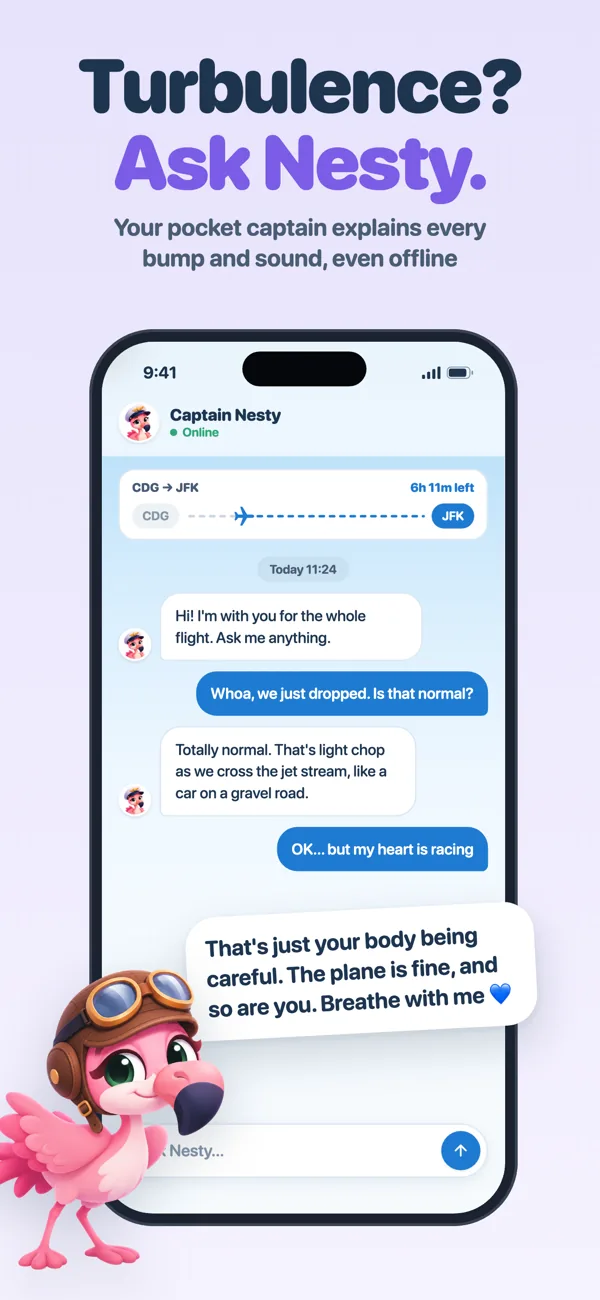
- Ask Nesty "Why did the propeller sound change?" and get a calm answer in seconds, even offline on supported devices. See Ask Nesty, your pocket captain.
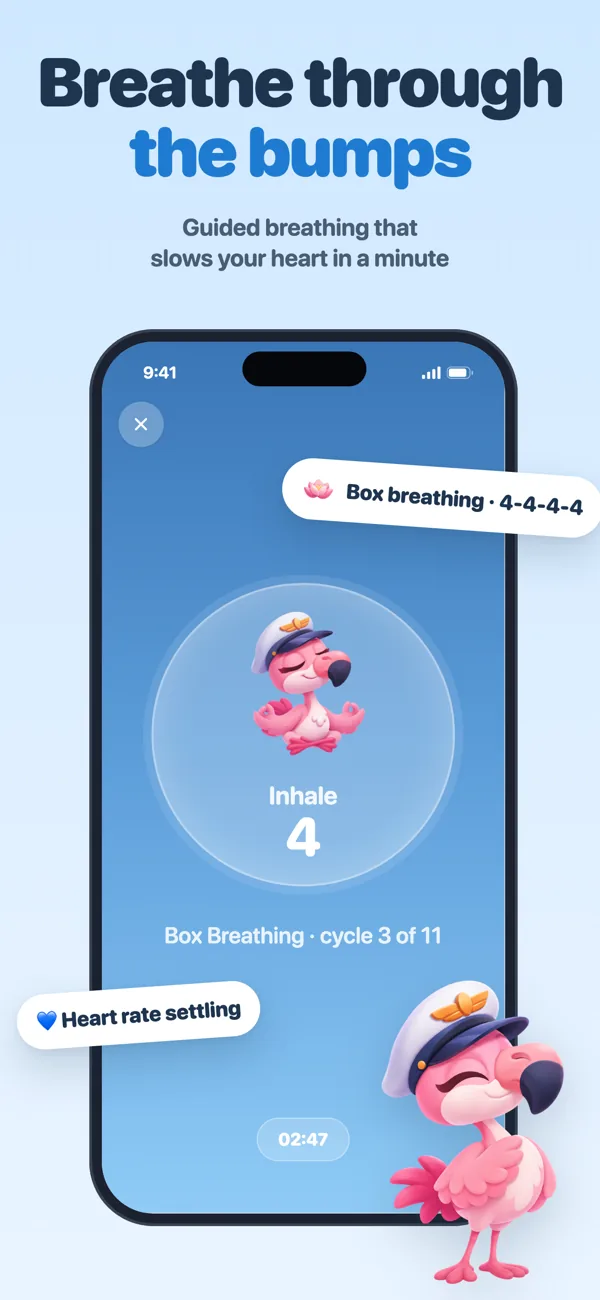
- Guided breathing and meditations for takeoff, turbulence and landing.
- A library of short reads about sounds, bumps and safety, to go through before you fly.
What FlyNest doesn't do
FlyNest can't tell you whether a specific charter company, aircraft or pilot is safe, and it doesn't check operators for you: the FAA's list is the place for that. It doesn't replace the pilot's instructions. If the fear is stopping you from traveling, a doctor or therapist can really help; see how therapy for fear of flying works.
Frequently asked questions
Are small planes safe?
It depends more on how the flight is operated than on size. A small airliner on a scheduled ticket flies under airline rules, and US airlines had no fatal accidents in 2024. General aviation has a clearly higher rate: 0.72 fatal accidents per 100,000 flight hours in 2024.
Are private jets safer than commercial flights?
No. US airlines are the safest kind of flying by a wide margin. In 2024 they had no fatal accidents, while on-demand charter, which includes most chartered private jets, had 0.14 per 100,000 flight hours. That is a low rate, but not the airline level.
Are turboprops safe?
A scheduled turboprop with more than 9 passenger seats flies under the same Part 121 airline rules as a large jet. Above that size, propellers don't move a scheduled flight into a different rule book.
Is turbulence worse on small planes?
You feel it more, because the effect of turbulence varies with the size of the aircraft. Keep your seatbelt on. Our guide on whether turbulence is dangerous goes further.
Why did they ask for my weight?
On a small aircraft, a few passengers make a real difference to the balance. Multi-engine operators must record weight and balance before each takeoff, so it's a routine safety step, not a comment on you.
Sources
- US Bureau of Transportation Statistics, U.S. Air Carrier Safety Data (table 2-9)
- US Bureau of Transportation Statistics, U.S. Commuter Air Carrier Safety Data (table 2-10)
- US Bureau of Transportation Statistics, U.S. Commuter Air Carrier Fatal Accidents (table 2-12)
- US Bureau of Transportation Statistics, U.S. On-Demand Air Taxi Safety Data (table 2-13)
- US Bureau of Transportation Statistics, U.S. General Aviation Safety Data (table 2-14)
- NTSB, Midair collision near Reagan National Airport (DCA25MA108)
- eCFR, 14 CFR 110.2 Definitions
- eCFR, 14 CFR 121.436 Pilot qualification
- eCFR, 14 CFR 135.243 Pilot in command qualifications
- eCFR, 14 CFR 135.101 Second in command required under IFR
- eCFR, 14 CFR 135.105 Exception to second in command requirement
- eCFR, 14 CFR 135.63 Recordkeeping requirements
- eCFR, 14 CFR 135.117 Briefing of passengers before flight
- FAA, Safe Air Charter
- FAA, Aviation Weather Handbook (FAA-H-8083-28B), Chapter 19 Turbulence