
Is fear of flying irrational? Why knowing it's safe doesn't stop the fear
You know the statistics, and you're still scared. Here is why knowing flying is safe doesn't switch the fear off, why more facts rarely help, and what to do when logic stops working.
You're aware of all the stats. You could explain to a friend why flying is one of the safest ways to travel. You're a capable adult who handles hard things every day, and yet, on a plane, a bump or a change in the engine sound is enough to make your heart race. Then comes the second feeling, the one that sits on top of the fear: "this is ridiculous, I know better". If that's you, you're not broken and you're not being silly. Knowing that flying is safe and feeling safe on a plane are two different things, and the gap between them is very common.
Practical answer
- Yes, the fear is out of proportion to the danger. No, that doesn't mean something is wrong with you. Many people with a phobia know their fear is irrational and feel it anyway.
- Fear is a fast body reaction. Facts are slow thinking. When fear is high, the facts are still true, they just don't reach the alarm in time.
- More statistics rarely help once you know them. Checking them again and again can even keep the fear going.
- When logic stops working, work with your body first: slow your breathing, with a long out-breath, for a few minutes.
- Treat the fear as a feeling to sit through, not a problem to solve with one more fact. Each flight you sit through teaches your body something facts can't.
- If the fear is shaping your life, talking therapies such as CBT have strong evidence behind them, and you can often start without a referral.
"I know it's illogical, so why am I still scared?"
Because a phobia doesn't depend on what you believe. The US National Institute of Mental Health (NIMH) defines a specific phobia as an intense, irrational fear of something that poses little or no actual danger, and adds something every nervous flyer will recognise: adults with phobias may realise their fears are irrational, but even thinking about facing the situation can bring on severe anxiety.
So knowing doesn't cancel the fear. You can hold both at once, completely sure the plane is safe and completely scared, and neither one proves the other wrong.
A useful way to picture it: fear works like a smoke alarm. It reacts in a split second, before you have time to think, and it reacts to signals like a sudden drop, an unfamiliar noise or not being in control. Your knowledge about safety is more like the fire inspector who arrives later with a report. The report is accurate. The alarm just doesn't wait for it.
That's why "trying to logic my way out of it" feels so tiring. You're arguing with something that isn't listening to arguments.
Is fear of flying irrational? An honest answer
In one sense, yes. Measured against the real risk, the fear is far bigger than the danger, which is exactly what makes it a phobia rather than ordinary caution. If you want the numbers once, our page on the chances of a plane crash sets them out calmly with its sources.
In another sense, no. The fear didn't come from nowhere, and it isn't a sign of weakness. The NHS explains that it's not always clear why phobias start, but many can be linked to a frightening event or a stressful situation, that you can learn a fear from family or friends who have it, and that phobias usually develop as a child, teenager or young adult. A rough flight years ago, a parent who gripped the armrest, a crash on the news at the wrong moment: any of these can teach the alarm to go off.
You're also far from alone. NIMH estimates that 9.1% of US adults had a specific phobia in the past year, and 12.5% will have one at some point in their lives. Fear of flying is one of the phobias the NHS names alongside heights and small spaces. Our aerophobia guide explains how it differs from ordinary nerves.
Why more statistics often don't help
When the fear arrives, the natural move is to look for one more reassuring fact: another safety figure, another explanation of turbulence, another search at midnight. It helps for a few minutes, then the fear comes back and asks again.
The NHS Every Mind Matters guide on anxiety notes that avoiding situations, or relying on habits we think will keep us safe, might actually make anxiety worse. Checking statistics over and over can become one of those habits. Each check teaches your mind that the fear was a real emergency that needed an answer.
This doesn't mean facts are useless. Learning how planes work, once, is a good thing, and many nervous flyers find it takes the edge off. The trouble starts when facts become a ritual. A simple test: if you already know the answer and you're looking it up again, it's the fear asking, not your curiosity.
What to do when logic stops working
If thinking can't switch the alarm off, the body is a better place to start. These steps work on the fear itself, not on your arguments with it.
- Name it. Say to yourself, "this is the fear, not information about this flight". It sounds small, and it helps you stop treating the feeling as a warning.
- Breathe slowly, with a long out-breath. The NHS breathing exercise for stress is simple: breathe in gently through your nose and out through your mouth, counting steadily from 1 to 5 if that helps, for at least 5 minutes. Our breathing exercises for flying explain three techniques you can use in your seat.
- Let the feeling rise and fall. A wave of fear usually builds, peaks and eases, even when it doesn't feel that way. Fighting it tends to keep it going. You don't have to feel calm to stay in your seat.
- Give your attention somewhere to go. Your hands, your feet on the floor, a film, the view, the time left on your flight. Not a search bar.
- Keep flying, in steps you can manage. The NHS advises facing fears gradually rather than avoiding them. Each flight you sit through, scared or not, is the kind of evidence your body can learn from.
The research points the same way. A 2008 meta-analysis of 33 randomised treatment studies on specific phobias found that exposure-based treatments, which help people face the feared situation step by step, outperformed placebo and other psychological approaches. In other words, what changes a phobia is mostly experience, not more information. Our fear of flying therapy guide explains what that looks like for flying.
"Other people don't understand"
A lot of nervous flyers carry a quiet layer of shame. Friends say "but it's safer than driving", and you nod, because you already know. Feeling silly about the fear can make it heavier: the NHS notes that being embarrassed about your reaction to a phobia can increase your anxiety.
It can help to say it out loud to one person you trust, in your own words: "I know it's safe. I'm scared anyway. I don't need the statistics, I need you to be patient with me." The NHS also suggests talking to someone you trust about a phobia, and joining a self-help group, online or in person, where others have the same experience.
When to get help
See a GP or a therapist if the fear is affecting your life: if you turn down trips you want to take, if you dread flights for weeks, or if the anxiety spreads beyond flying. The NHS lists talking therapies such as cognitive behavioural therapy (CBT) among the treatments for phobias, and in England you can refer yourself to an NHS talking therapies service without a GP referral. If you're not sure what kind of fear you have, our free flight pattern quiz can help you put words to it before that conversation.
How FlyNest helps
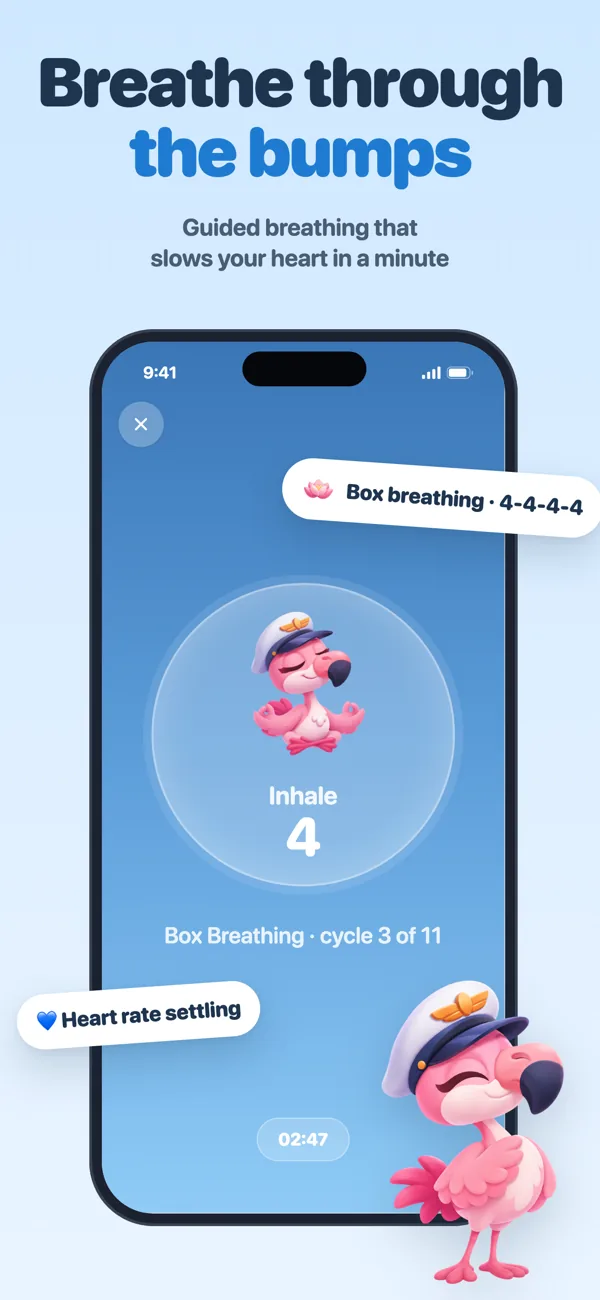
FlyNest is built for the moment when you know better and feel scared anyway. Instead of another statistic, it gives your body something to do: a guided breathing exercise you can follow with your eyes closed, in about a minute, with box breathing, cardiac coherence or 4-7-8.
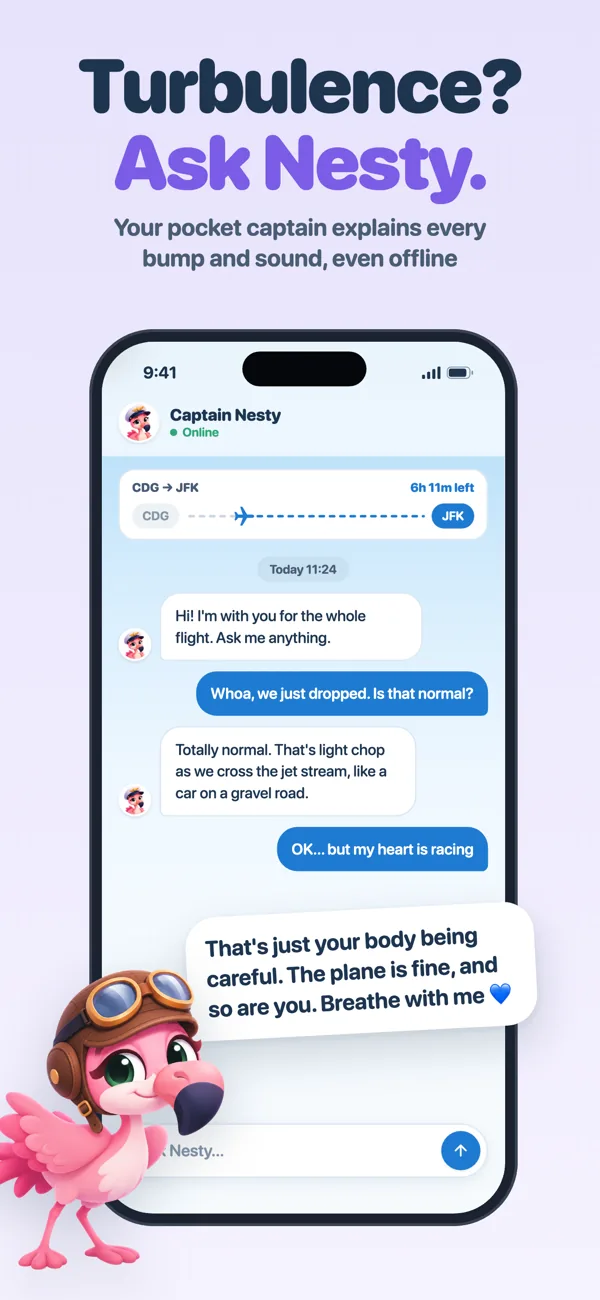
And for the questions you'd be embarrassed to ask out loud, there's Nesty, the app's pocket captain. "Is that noise normal?" "Why did the engines get quieter?" You can ask anything, as many times as you need, and Nesty answers in plain words with your flight in mind, without anyone raising an eyebrow. If it's your body that needs calming rather than your thoughts, Nesty can point you to a breathing exercise instead.
What FlyNest doesn't do
FlyNest won't argue the fear away, and it isn't a treatment for phobias. It helps you through the moments when logic isn't enough, so you can keep flying while the fear slowly gets smaller. If the fear is holding you back, a therapist who offers CBT or exposure-based treatment is the right next step, and the app can sit alongside that help. If you've looked at a structured program like SOAR and it didn't fit, our page on SOAR alternatives compares the apps and fear of flying courses people use instead.
Frequently asked questions
Is fear of flying irrational?
It's out of proportion to the real danger, which is what makes it a phobia. But it isn't random or a sign of weakness. Phobias are often linked to a frightening experience or learned from people around us, and NIMH notes that many adults with a phobia know their fear is irrational and still feel it strongly.
Why am I scared of flying if I know it's safe?
Because fear and knowledge work on different tracks. Fear is a fast, automatic reaction to signals like bumps, noises and not being in control. Knowledge is slower. You can be sure flying is safe and still feel the alarm, and the alarm doesn't mean your knowledge is wrong.
Why don't statistics help my fear of flying?
Once you know them, more statistics rarely reach the fear. Checking them again and again can even keep it going, because it treats the feeling as an emergency that needs an answer. Learning the facts once is useful. After that, breathing, attention and gradual flying help more.
Can you be a confident adult and still be scared of flying?
Yes, and many are. Specific phobias are common: NIMH estimates that 12.5% of US adults have one at some point in their lives. Being scared on a plane says nothing about how capable you are anywhere else.
Will the fear go away if I keep flying?
For many people it gets smaller with practice, especially when they sit through the fear instead of fighting or escaping it. Research on specific phobias supports facing the feared situation step by step. If it isn't easing, or it's affecting your life, a therapist can guide that process.