
British Airways Flying with Confidence in 2026: the course, the cost and the alternatives
What the British Airways fear of flying course, Flying with Confidence, includes in November 2026, the dates and prices at Heathrow and Glasgow, the online version, what its 98% figure measures, and the alternatives.
If you are looking up the British Airways fear of flying course, you have probably reached the point where the fear is costing you something: a holiday, a wedding abroad, a job that asks you to travel. Flying with Confidence is the course's name. By its own account it was the first fear of flying course in the UK, and it does something a video can't: it ends with you on a real plane, with the people who taught you sitting nearby.
This page sets out what the day involves, what it costs, what the online version covers and what the course's success figure measures, then where else to turn if it isn't the right fit. We make FlyNest, one of the alternatives below, so read that entry with it in mind. Everything about the course comes from its official website, read on 20 November 2026. We have not taken the course and we don't score it. Dates and prices change, so check before you pay.
Practical answer
- What it is: a one-day course run with British Airways pilots, cabin crew and psychologists. A technical session in the morning, a psychology session in the afternoon, then a short flight on a BA jet with a pilot's commentary.
- What it costs: £399 at London Heathrow and £299 in Glasgow for the standard day (Primary). Smaller groups cost more: £799 for a group of up to 10, £1,595 for a group of up to four.
- Next dates listed: Heathrow on 21 November 2026 and 23 January 2027, Glasgow on 20 March 2027.
- Online instead: 11 video topics, just over 90 minutes in total, from £79.99 for 30 days. The first two topics are free when you register.
- Who it suits: adults in or near the UK who want to face the flight itself in one structured day, with experts beside them.
- If it doesn't fit: easyJet Fearless Flyer for a cheaper online course, a therapist if the fear is severe, and FlyNest (our app) for help on your own flights.
What happens on the day
The course site describes the standard day like this:
- Morning, the technical session. The day usually starts around 9:00. The site says the day's topics run from how planes fly through to understanding fears, and this is the flying half, led by pilots.
- Lunch. It is provided, with vegetarian, vegan and gluten-free options. You can bring your own food if that feels easier.
- Afternoon, the psychology session. A psychologist explains why fears like this take hold, including claustrophobia and fear of heights, and teaches relaxation techniques you can use on the flight.
- The flight, at around 17:00. A short flight on a BA jet of the kind used on its short-haul routes. The course's pilots, cabin crew and psychologists come with you, alongside the normal operating crew, and an extra pilot on the flight deck explains each phase of the flight as it happens.
- Finish, at around 18:30, depending on delays. The site suggests you keep the evening free.
The flight lasts 45 minutes at most. In the site's words, the plane takes off, climbs for about ten minutes and, after a short cruise, returns to the airport it left from.
A few practical points from the course's FAQ:
- You must be 18 or over. The courses are not open to children or teenagers.
- Bring government photo ID, preferably a passport or a driving licence.
- You can ask for a seat type when you book (front, back, window or aisle). The team says it tries to meet requests but can't always.
- Assistance can be arranged for wheelchair users, on the course, through the airport and on board, once you have booked.
- The course does not use hypnosis. The FAQ says it takes "a more cognitive behavioural therapy approach".
- Refunds are short. A full refund is given within 24 hours of booking. After that, bookings cannot be cancelled or transferred.
Do I have to go on the flight?
No. The FAQ is plain about it: nobody is forced to do anything they don't want to do. The team will encourage you to go as far as you feel able to on the day, and it adds that for some people, stepping onto the aircraft is enough. If you decide to leave before departure, a member of staff walks you back through security, and you can buy a flight-only ticket to try again on a later course.
If you are reading this thinking you would be the one who can't board, the course has heard it before. Its FAQ says everyone who comes thinks they will be the worst one there. You don't have to arrive calm either. Our page on being scared to fly and going anyway is about exactly that.
What it costs, option by option
These are the options and prices listed on the course site on 20 November 2026.
| Option | What you get | Price (Nov 2026) |
|---|---|---|
| Primary | The full day and the flight | £399 at Heathrow, £299 in Glasgow |
| Primary Plus | The same day and the same flight in a group of up to 10, with front-row seats, a pilot or psychologist on your row, a waiter-service lunch and the course book | £799 (Heathrow) |
| Premium | A group of up to four with the most experienced team members, then two scheduled BA domestic flights with a pilot or psychologist beside you | £1,595 (Heathrow) |
| Private | One to one with a captain and a psychotherapist, with two scheduled BA domestic flights | By phone |
| Flight only | The afternoon flight, for a supporter or as a top-up after a past course | £179 at Heathrow, £149 in Glasgow |
| Online course | 11 video topics, watched at your own pace | £79.99 for 30 days, £149.99 for 3 months, £199.99 for 12 months |
The site says its prices include VAT, Air Passenger Duty and card charges, with nothing added at checkout.
The dates listed today. Primary and Primary Plus run at Heathrow on Saturday 21 November 2026 and Saturday 23 January 2027. Glasgow has a Primary course on Saturday 20 March 2027. The Premium day on Wednesday 2 December 2026 was fully booked, with a waiting list. A half-day "ground only" course without a flight exists, but no dates were listed. The site also names Gatwick, Edinburgh, Dubai, Perth and Sydney as venues. It says the Dubai and Perth courses are ground based only, and none of those venues had dates on the courses page today. You can register on the site to hear when new dates open.
Can someone come with you?
A friend or relative can't sit in the room with you during the sessions. The site asks supporters to leave you for the day, and says that meeting other people who feel the same way is part of what helps. They can join you for the flight with a flight-only ticket, and the FAQ asks that this person be a comfortable flyer.
If you are the one doing the supporting, our page on how to help someone with a fear of flying covers what to say and what to leave unsaid.
The flight-only ticket also works as a top-up for people who have already taken the course. The site is not consistent about how recently: the courses page says within the last two years, the FAQ says within the past five. Ask before you book one.
The online course
The online version is presented by Captain Steve Allright, a British Airways training captain who has run these courses for about 30 years. It has 11 video topics. The FAQ gives the total as just over 90 minutes.
The topics, as the site lists them: what causes a fear of flying, the principles of flight and turbulence, how pilots are selected, trained and tested, flight controls, flaps and slats (filmed on a Boeing 747 flight deck), sounds and sensations, a second part on turbulence, weather, air traffic control and security, understanding anxiety, and a "breathe and squeeze" technique to relax.
Three things to know before you buy:
- It needs the internet. The FAQ says the course can't be downloaded to watch offline. You can watch it before your flight, but not in airplane mode.
- Access ends. 30 days, 3 months or 12 months, as a one-off payment with no auto-renewal. If your flight is months away, choose the length with that date in mind.
- You can try it first. Registering gives you the first two topics free.
If the sounds are what get to you, our guide to airplane noises during a flight goes through them in flight order, and our turbulence guide looks at what the injury figures say.
What the 98% success rate measures
The site says more than 50,000 people have attended since the courses began in 1986, and it quotes a 98% success rate. Unlike most courses, it also says how the figure is worked out: it is based on the number of people who make it onto the aircraft, and on the feedback they give after the flight.
That is worth reading carefully. It tells you that nearly everyone who attends boards the plane at the end of the day, which is a real result for people who arrived unsure they could. It is not a measure of how those people feel on their own flights months later, and it is the provider's own figure, not an independent study.
The shape of the day does match what research supports. A 2008 meta-analysis of 33 randomised studies on specific phobias found that exposure-based treatment, facing the feared situation step by step, did better than placebo and other approaches. The NHS lists talking therapies such as cognitive behavioural therapy (CBT) among the treatments for phobias. A course that explains, teaches a technique and then takes you flying is built on the same idea, in one day and in a group.
Who it suits, and who might look elsewhere
It suits you if:
- You want the flight itself to be part of the help, not something you face alone afterwards.
- You do better with real people in a room than with videos.
- You can get to Heathrow or Glasgow on one of the listed dates.
You might look elsewhere if:
- You live outside the UK, or the dates don't fit. The online course is the part you can take from anywhere.
- The price is out of reach. The standard day costs several times the price of an online course.
- The fear is severe, long-standing, or comes with panic attacks you can't manage. A therapist can work on your own fear at your own pace.
- You are under 18.
- Your hardest moments come on ordinary flights, weeks or months later, when the course team isn't on board.
Alternatives to Flying with Confidence
| Option | Format | Help during the flight | Where | Price (Nov 2026) |
|---|---|---|---|---|
| BA Flying with Confidence (reference) | One-day course in person, or online videos | A flight of up to 45 minutes with the course team, on the day | London Heathrow, Glasgow; online anywhere | Day course £299 to £399; online £79.99 to £199.99 |
| easyJet Fearless Flyer | Online course, about 2.5 hours | Audio commentary and talk-down audio, with the Premium option | Online anywhere | €97 (30 days) or €167 (lifetime) |
| FlyNest (our app) | In-flight companion app | Ask Nesty, offline live map, breathing, meditations by flight phase | iPhone, iPad, Android | Free download, then a weekly or yearly subscription |
| CBT with a therapist | Weekly sessions | Not usually, though exposure may include flying | Where you live, or online | Free on the NHS in England; private fees vary |
easyJet Fearless Flyer
The lower-cost route. easyJet's online course runs about 2.5 hours in 16 modules, with a senior easyJet captain on the technical side and a phobia expert on the psychological side. On its site today it costs €97 for 30 days, or €167 for lifetime access with extra audio you can play during a flight. Its site says live courses run in the UK, but we could not find current dates when we looked on 16 November 2026. Our page on easyJet Fearless Flyer goes through it in detail, and our fear of flying courses compared page sets both airline courses beside SOAR and VALK.
FlyNest (our app)
FlyNest isn't a course, and it doesn't replace one. It is built for the flights that come after: your own flight, on your own route, when the engines change pitch and the person who explained it all isn't sitting beside you.
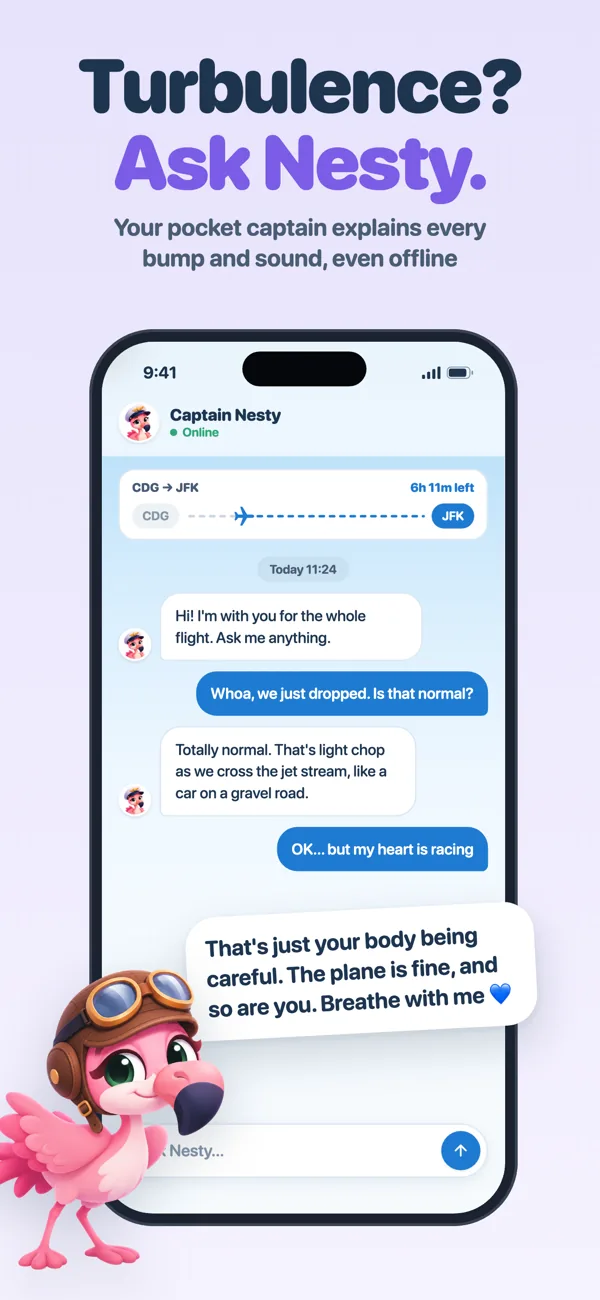
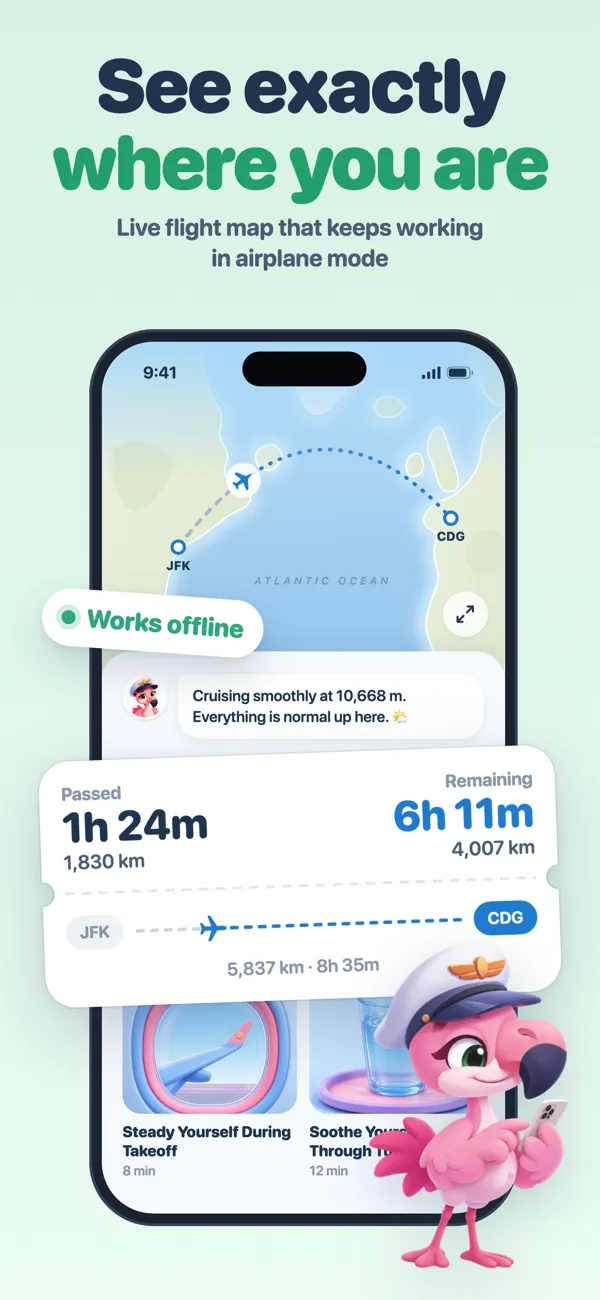
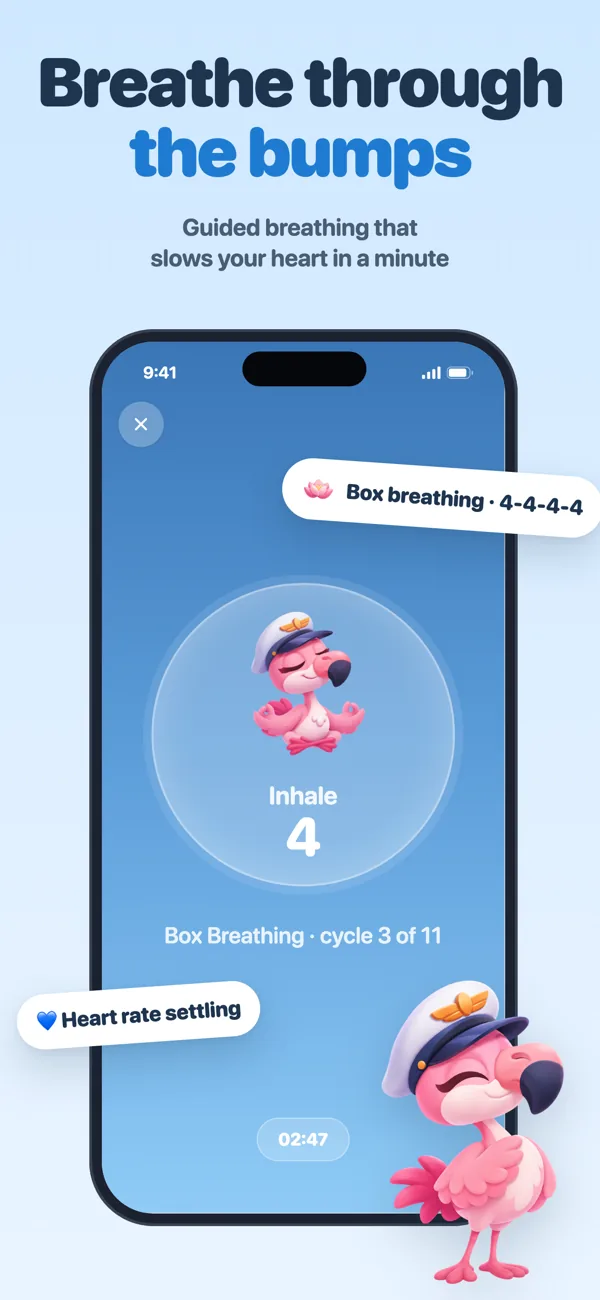
You can ask Nesty, the pocket captain, "was that bump normal?" or "why did the engines go quiet?" and get a plain answer that knows your route and your flight phase, offline on supported devices. The live map works in airplane mode, with time passed and time remaining. There are three breathing techniques, 12 meditations for takeoff, turbulence, cruise and landing, and 80 short reads about sounds and safety.
- Who it suits: people whose worst moments are on board, alongside a course or on its own.
- Limits: no counseling, no video course and no group flight with experts. It is new, with no ratings yet on the US or UK App Store.
- Price: free download, then a weekly or yearly subscription ($8.99 a week or $69.99 a year on the US App Store).
CBT with a therapist
If the fear is stopping you from flying at all, or panic feels out of control, a therapist is the right first step. In England you can refer yourself to NHS Talking Therapies without seeing a GP. Our fear of flying therapy guide explains what to expect.
If you would rather start with an app, our list of the best fear of flying apps puts eight of them side by side.
Frequently asked questions
How much is the British Airways fear of flying course?
On the official site in November 2026, the standard one-day course (Primary) costs £399 at London Heathrow and £299 in Glasgow. Primary Plus, in a group of up to 10, costs £799, and Premium, in a group of up to four, £1,595. The online course costs £79.99 for 30 days, £149.99 for 3 months or £199.99 for 12 months.
Where and when does the BA fear of flying course run?
The dates listed on 20 November 2026 were London Heathrow on 21 November 2026 and 23 January 2027, and Glasgow on 20 March 2027. The site also names Gatwick, Edinburgh, Dubai, Perth and Sydney as venues, without dates on the courses page that day. The site says it adds dates regularly.
How long is the flight on the Flying with Confidence course?
The course's FAQ says the flight is a maximum of 45 minutes. The plane takes off, climbs for about ten minutes, cruises briefly and returns to the same airport, with a pilot giving a commentary from the flight deck.
What if I can't get on the plane?
Nobody is forced to board. The course team encourages you to go as far as you can, and says that for some people stepping onto the aircraft is enough for that day. If you leave before the flight, staff walk you back through security, and you can buy a flight-only ticket for a later course.
Does the British Airways fear of flying course work?
The course quotes a 98% success rate, based on how many people board the flight and the feedback they give afterwards. That is its own figure. Research on phobias supports facing the fear step by step, which is how the day is built. If the fear is severe or comes with panic attacks, talk to a doctor or a therapist as well.
Is the online Flying with Confidence course worth it?
It covers the same ground as the day's teaching in 11 video topics, just over 90 minutes, from £79.99. It has no flight and no one to ask, and it can't be watched offline. The first two topics are free when you register, so you can judge it before paying.
Sources
- Flying with Confidence, course options, dates and prices
- Flying with Confidence, frequently asked questions
- Flying with Confidence, about the courses
- Flying with Confidence, venues
- Flying with Confidence online course
- easyJet Fearless Flyer, online course and prices
- NHS, Treatment for phobias
- NHS Talking Therapies
- Wolitzky-Taylor et al., Psychological approaches in the treatment of specific phobias: a meta-analysis (2008)
- FlyNest on the App Store
- FlyNest on Google Play