
Scared to fly? You don't have to feel calm to get on the plane
You have a flight coming and you're scared to fly. You don't need to feel calm before you board. Here is how to fly while scared, with a plan for the gate, takeoff and the hours in the seat.
You're scared to fly, and the flight is coming anyway. Maybe you keep waiting for the morning when you wake up and feel ready. Maybe you've told yourself you'll go once the fear is gone, and it hasn't gone. Here is something that people who fly with this fear often find out late: you don't have to feel calm to get on the plane. You can do it scared. A flight you spent with a tight chest and damp hands is still a flight you took.
Practical answer
- Don't wait to feel ready. For many nervous flyers that feeling never arrives on its own.
- Being scared is not a sign that something is wrong with the plane, or with you.
- Decide in advance what you'll do, not how you'll feel: get to the gate, sit down, fasten the belt.
- Cut the flight into small parts and take one at a time: boarding, takeoff, the first ten minutes, cruise, descent.
- Give yourself something to look at and something to do: a flight map with the time left, slow breathing, a film.
- If fear is deciding where you can and can't go, talk to a doctor or a therapist. It is treatable.
"I'll go when I feel calm"
It sounds reasonable: first get rid of the fear, then book the trip. The trouble is the order. Staying on the ground feels better today, and the fear is still there for the next trip. The NHS puts it plainly: avoiding situations, or relying on habits we think will keep us safe, might actually make anxiety worse, and slowly facing up to a situation might help.
Knowing the facts doesn't change the order either. The US National Institute of Mental Health notes that adults with a phobia may realise their fear is irrational, and that even thinking about the feared situation still brings on severe anxiety. So "I know it's safe" and "I'm scared to fly" can both be true on the same morning. Our guide on why knowing flying is safe doesn't stop the fear is about that gap.
You're also far from the only one. NIMH estimates that 12.5% of US adults have a specific phobia of some kind at some point in their lives, and the NHS lists flying among the typical situations.
You didn't get on that flight feeling calm, and that's fine
Courage on a plane rarely looks like calm. It looks like someone gripping the armrest who stayed in the seat.
There is some research behind this, with a caveat. It comes from exposure therapy, where people face a fear step by step with a therapist, not from single holiday flights. A 2014 paper by Michelle Craske and colleagues reviewed that research and reported that how much a person's fear drops during an exposure does not predict how they do later. In other words, the session where someone stayed scared the whole time was not a wasted session. One flight is not therapy, and we won't promise that this trip will shrink your fear. But the idea is a kind one to carry on board: you are not being graded on how calm you feel. Shaking through takeoff is not failing.
What the fear does to your body is unpleasant, and it is not dangerous. Anxiety is a natural response to feeling afraid or threatened, as the NHS describes it. Even at its strongest, as a panic attack, the NHS says it is frightening but not dangerous, and that most attacks last between 5 and 20 minutes. A flight is longer than a wave of fear. The wave passes and you're still in your seat, on your way.
How to fly when you're scared
You can't order yourself to be calm. You can decide what you'll do. A plan made of actions holds up better than a plan made of feelings.
- Promise the action, not the mood. "I will board" is a promise you can keep. "I will be relaxed" isn't.
- Tell one person. The NHS suggests talking to someone you trust about a phobia. A travel companion, a friend by text before the doors close, or a flight attendant if you'd like them to know. That last one is your choice.
- Arrive early. A rushed airport makes everything louder.
- Cut the flight into parts. You only have to do the next one: walk down the jet bridge, sit, belt on, takeoff, the first ten minutes. Then cruise, which is mostly waiting.
- Breathe slowly when it rises. The NHS breathing exercise fits a plane seat: in gently through the nose, out through the mouth, counting from 1 to 5 each way, for at least 5 minutes.
- Watch the flight get shorter. Fear says "this will never end". A map with the time remaining answers it every time you look.
- Let the fear come along. You don't have to win an argument with it. It can sit there while you watch a film badly.
- Notice it when you land. You were scared, and you did it. Both are true.
If the days before are the hardest part for you, our page on anxiety before a flight gives them a shape, and flying tomorrow and panicking is for the night before. If the fear peaks sharply on board, keep what to do in a panic attack on a plane saved on your phone.
"None of the things I pictured happened"
Before a flight, the mind writes a film: the takeoff that goes wrong, the bump that doesn't stop, the moment you lose control in front of everyone. That film is made by fear, not by information about your flight.
You don't need to argue with it scene by scene. A lighter exercise is to write down, before you leave, the two or three things you're most sure will happen. After landing, read the list. Whatever you find, it is your own evidence, from your own flight, and it tends to be more convincing than any number someone else gives you.
When scared is more than nerves
Flying scared is a fair choice. Suffering for years is not something you have to settle for. The NHS advises seeing a GP if you think you have a phobia and the symptoms are affecting your life, and it lists talking therapies such as cognitive behavioural therapy (CBT) among the treatments. In England you can refer yourself to NHS Talking Therapies without seeing a GP. The NHS also suggests checking whether airlines run sessions for people with phobias: we compare them in our fear of flying courses guide, our page on the British Airways Flying with Confidence course shows what one of those days involves, and our fear of flying therapy guide explains what treatment looks like.
How FlyNest helps
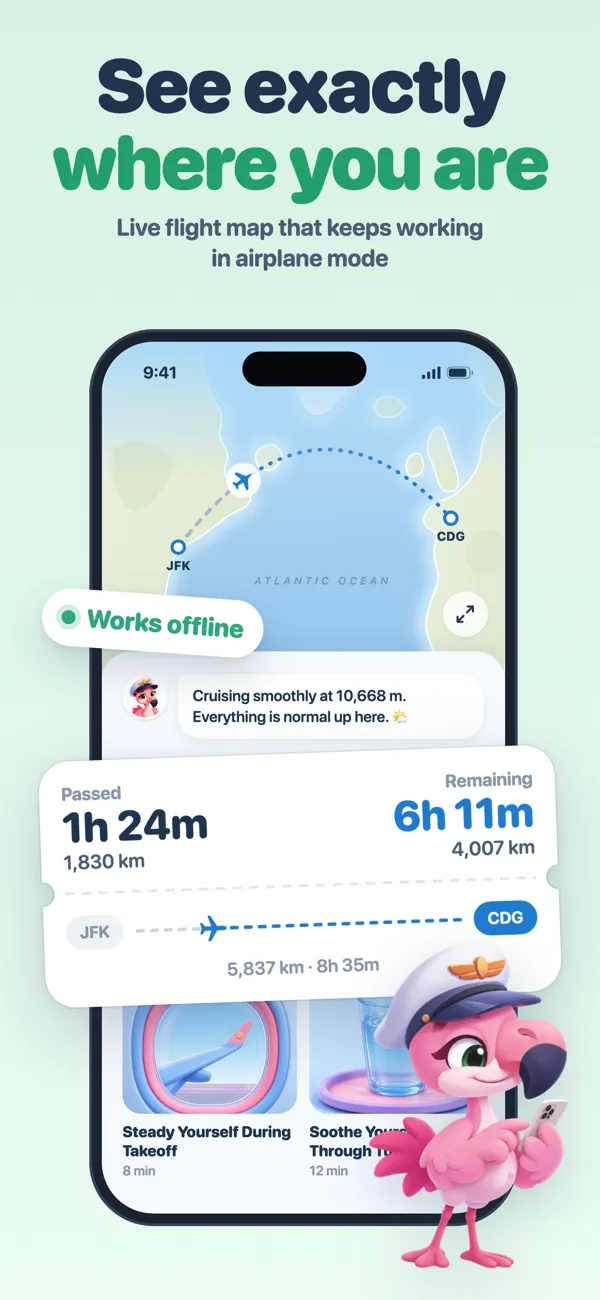
FlyNest is built for the flight you take while still scared. The part that fits this moment best is the flight map. You save your route before you leave, and in the air it works in airplane mode, with no Wi-Fi: where you are along the route, the time passed, the time remaining and what comes next. When fear tells you the flight is endless, the map shows that it's getting shorter. See the live flight map that works offline.
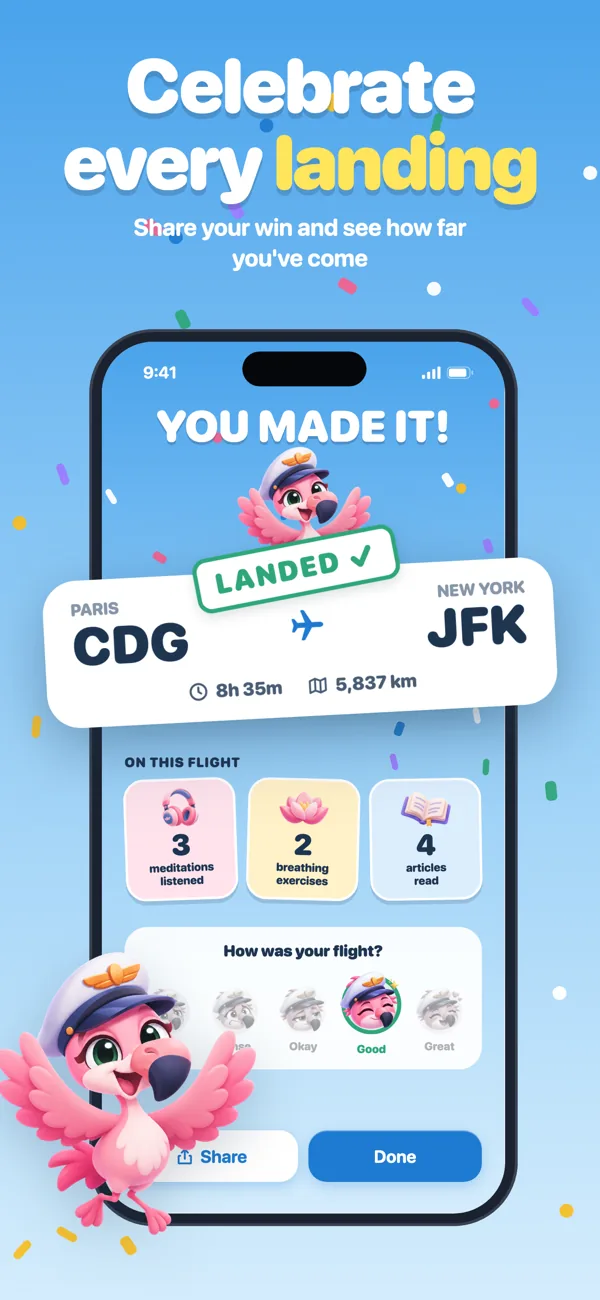
Around it, there is guided breathing for flying for the moments when the fear rises, and a "You made it!" screen after landing, with a history of your flights. It keeps a record of the flights you did scared.
What FlyNest doesn't do
FlyNest won't make you calm, and it doesn't treat a phobia. The map shows your own estimated position along your route. It isn't live radar and it doesn't know what the crew knows, so their announcements are always the official word. If fear of flying is limiting your life, a doctor or a therapist is the right next step, and the app can sit alongside that help.
Frequently asked questions
Is it normal to be scared to fly?
Yes. The NHS lists flying among the situations that phobias are typically about, and NIMH estimates that 12.5% of US adults have a specific phobia of some kind in their lifetime. Being scared doesn't mean anything is wrong with you or with the flight.
Can I fly if I'm still scared?
Yes. You don't have to feel calm before you board. Plan what you will do rather than how you will feel: get to the gate, sit down, breathe slowly, follow the flight on a map. Many people fly scared, and the flight counts all the same.
Will flying scared make my fear worse?
Avoiding flights is what tends to keep anxiety going, according to the NHS, while facing a fear gradually can help. One hard flight is not a step backwards. If flights stay very distressing, a doctor or a therapist can help you face them in smaller steps.
I'm not cured. Does this flight still count?
It counts. Nobody checks how calm you were. You got on, you stayed, you landed. Research on exposure therapy found that how much fear drops during an exposure doesn't predict how a person does later, so a scared flight is not a wasted one.
What should I do if the fear spikes during the flight?
Breathe in gently through the nose and out through the mouth, counting from 1 to 5 each way, for a few minutes. Look at the time remaining and remind yourself that the wave passes. The NHS notes that panic attacks are frightening but not dangerous.
Should I cancel my flight if I'm too scared?
That decision is yours, and nobody should force you. It helps to know that, according to the NHS, avoiding a situation can make anxiety worse. If this flight is truly too much, look for a smaller step, such as a shorter flight, and consider talking to a doctor or a therapist.